Downsizing Your Home in Retirement: A Canadian Guide
What downsizing can free up, how the principal residence exemption works, and how to test a home sale in your retirement plan before you commit.

For many Canadian homeowners, the house is the largest single asset on the balance sheet — often worth more than the investment accounts combined. So it's natural that a question comes up again and again as retirement approaches: should we sell, downsize, and put the difference to work?
TL;DR: Selling a home that qualifies as your principal residence is generally tax-free, though the sale still has to be reported to the CRA. The freed-up equity can meaningfully strengthen a retirement plan — but an often-missed part is what happens after the sale: investing the proceeds can create taxable income that affects OAS clawback and GIS. It tends to be worth modelling before you list.
What downsizing can actually free up
The number that usually matters most isn't the sale price — it's what's left after everything else:
Sale price − remaining mortgage − cost of the new home − transaction costs
Transaction costs are easy to underestimate. Real estate commissions, legal fees, moving costs, and land transfer tax on the new purchase (which varies by province, and can be doubled in Toronto by the municipal tax) often add up to several percent of the combined transaction. A $900K sale funding a $600K purchase usually frees up quite a bit less than a clean $300K.
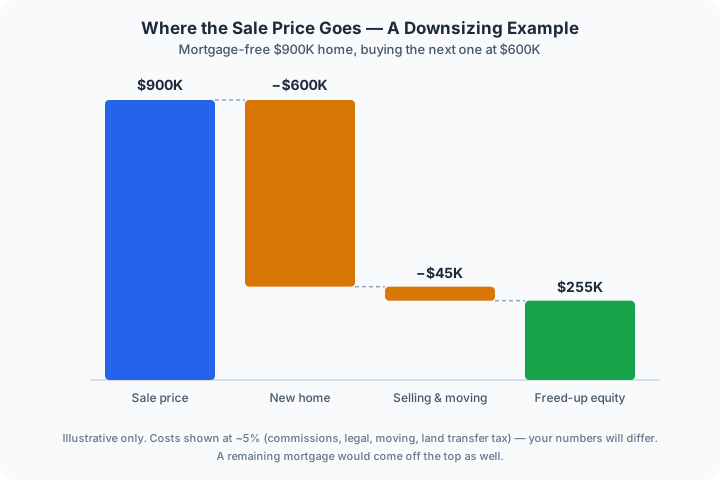
Many households find the freed-up equity lands somewhere between "helpful cushion" and "changes the whole plan" — which is why it tends to be worth running the numbers rather than guessing.
The tax side: usually friendly, with one catch
The principal residence exemption
If the home was your principal residence for every year you owned it, the capital gain is generally exempt from tax. This is one of the more generous provisions in Canadian tax law, and a big part of why downsizing tends to compare well against drawing down an RRSP or RRIF, where withdrawals are taxed as regular income.
The catch: since 2016, the sale still has to be reported on your tax return (Schedule 3, plus Form T2091) to claim the exemption. It's a paperwork step, not a tax bill — but missing it can put the exemption at risk.
Cottages and rentals are different
A second property — cottage, rental, investment condo — doesn't get the exemption (only one property per family unit can be designated for a given year). When it's sold, 50% of the capital gain is taxable at your marginal rate (2026 — the proposed increase to the inclusion rate was cancelled). A large gain landing in a single tax year can also push income past benefit thresholds, which is where the next section comes in.
The part plans tend to miss: after the sale
The sale proceeds themselves generally aren't taxable income. But what you do with them can create income:
- Invested in a non-registered account, the proceeds tend to generate interest, dividends, and capital gains — income that counts toward OAS clawback (which begins at $95,323 of 2026 income) and, for lower-income retirees, GIS eligibility.
- TFSA room can shelter part of it. The 2026 annual limit is $7,000 per person, and unused room accumulates — someone who has never contributed may have up to $109,000 of room, or $218,000 for a couple. Under current rules, money inside a TFSA generates no taxable income and doesn't count in OAS or GIS calculations.
- Timing interacts with everything else. A downsize in your active years looks different from one forced later by health or upkeep — and the year you choose can change which tax brackets and benefit thresholds the resulting income runs into.
What a simulation can show before you list
This is a decision where the pieces — sale price, new home cost, transaction costs, the exemption, TFSA room, OAS and GIS effects — interact in ways that are hard to eyeball.
RetireZest lets you model a planned downsize directly: the year you expect to sell, the expected sale price, the cost of the new home, and whether the property qualifies as a principal residence. The simulation then shows, year by year, what the freed-up equity does to your income, taxes, and estate — and your Zest Score helps you see whether the move genuinely strengthens the plan or mostly shuffles the furniture.
Frequently asked questions
Is selling your home in retirement tax-free in Canada?
Generally yes, if the home qualifies as your principal residence for every year you owned it — the principal residence exemption applies. The sale must still be reported on your tax return (Schedule 3, plus Form T2091) to claim the exemption. Second properties such as cottages and rentals do not qualify, and 50% of their capital gain is taxable.
Does downsizing affect OAS or GIS?
The sale proceeds themselves generally are not taxable income, but investing them outside registered accounts creates interest, dividends, and capital gains that count toward the OAS clawback threshold ($95,323 of 2026 income) and the GIS income test. Money moved into a TFSA does not count in either calculation under current rules.
How much money does downsizing actually free up?
Usually less than the simple price difference between the two homes. Real estate commissions, legal fees, moving costs, and land transfer tax on the new home often add up to several percent of the combined transaction, and any remaining mortgage comes off the top as well.
Model your downsize before you list
Sale price, new home cost, the exemption, and what the freed-up equity does — mapped year by year.
Model my downsizeRetireZest is an educational retirement planning tool and does not provide personalized financial, tax, or legal advice. The calculations and projections are estimates based on current government rates and the information you provide. Rules around the principal residence exemption depend on your specific situation. Always consult a licensed financial advisor or tax professional before making financial decisions.
Related Articles
Canadian Retirement Numbers 2026: The Key Figures
CPP, OAS, GIS, TFSA, RRSP, RRIF minimums, and the 2026 tax thresholds that shape Canadian retirement plans — collected on one page.

Retiring at Different Times: A Guide for Canadian Couples
Many couples retire years apart. How a staggered retirement affects income, CPP and OAS timing, and household taxes — and how to plan it together.
Inflation Is Rising — Should Your Retirement Plan Change?
Canada's headline inflation jumped on gas prices. What monthly CPI numbers mean — and don't mean — for the inflation assumption in your retirement plan.