Retiring at Different Times: A Guide for Canadian Couples
Many couples retire years apart. How a staggered retirement affects income, CPP and OAS timing, and household taxes — and how to plan it together.

Many couples don't share a retirement date. An age gap, different careers, one pension that matures earlier than the other — in plenty of households, one partner stops working years before the other. That's not a complication to apologize for; handled well, it can be one of the stronger setups in retirement planning.
TL;DR: When one partner keeps working, their income can bridge the household for years — fewer early withdrawals, more flexibility on when each person starts CPP and OAS, and often some low-income years the retired partner can use for tax-efficient RRSP withdrawals. The main planning shift tends to be moving from two individual plans to one household plan.
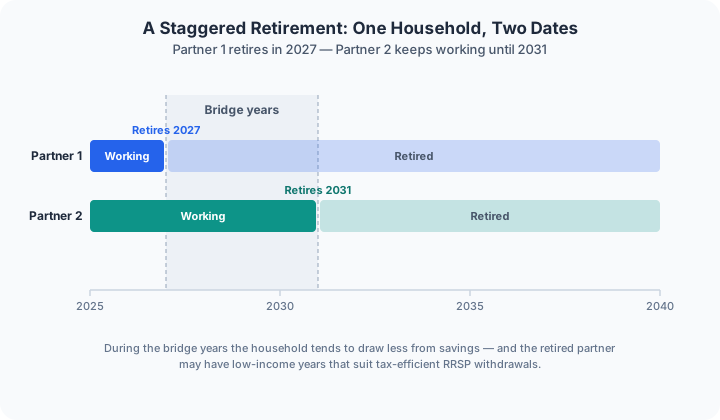
The bridge years
While one partner is still earning, the household often doesn't need to draw much from savings. That has two quiet benefits:
- Less sequence-of-returns risk. The early retirement years tend to be when a market drop hurts most, because withdrawals lock in losses. A working partner's paycheque can mean fewer forced withdrawals in those years. (More on this in our sequence of returns guide.)
- Low-income years for the retired partner. With little personal income, the retired partner may sit in a low tax bracket for several years — often a good window for deliberate RRSP withdrawals before mandatory RRIF minimums begin. This is the logic behind the RRSP meltdown strategy, and a staggered retirement can widen the window.
Government benefits are individual
CPP and OAS decisions are made per person, not per couple:
- CPP can start anywhere from 60 to 70 — reduced by 0.6% per month before 65 (36% less at 60), increased by 0.7% per month after 65 (42% more at 70). Details in when to take CPP.
- OAS can start between 65 and 70, growing 0.6% per month deferred (36% more at 70).
A staggered retirement often means the two partners face different answers. A still-working partner might lean toward delaying benefits (stacking CPP on top of employment income can push it into a higher bracket, or toward the OAS clawback threshold — $95,323 of 2026 income), while the retired partner's answer depends on how the bridge years are being funded. Testing the combinations can surface options that a default of 65-for-both would miss.
Some tax tools only exist at the household level
- Pension income splitting. Up to 50% of eligible pension income can be shifted to the lower-income spouse on the tax return (Form T1032) — an optional election made each year, so it only comes into play in years where it helps. RRIF withdrawals qualify once the transferring spouse is 65; some employer pension payments can qualify earlier, though Quebec allows provincial-side splitting only from 65. No money moves; only the tax bill does. CPP isn't part of this election, though it has its own sharing mechanism through Service Canada. Our pension splitting guide covers the details.
- Contribution room doesn't stop at the first retirement. A partner who is still working keeps generating RRSP room (contributions are possible until the end of the year they turn 71) and both partners keep accruing TFSA room ($7,000 each in 2026). A spousal RRSP is another household-level option some couples use to balance retirement income between partners.
Seeing it as one household
For many couples, the tricky part of a staggered retirement isn't any single decision — it's that the decisions can interact. When the second retirement lands, when each CPP starts, which accounts fund the bridge years, and how income splits after 65 often pull on each other. Not every household will see a big difference from coordinating these — but it's hard to know whether yours would without testing your own numbers.
RetireZest models this directly: each partner gets their own retirement age, the still-working partner's income and contributions keep building through the bridge years, and withdrawals begin only for the partner who has retired. You see the whole household year by year, and your Zest Score shows whether the plan holds together across both retirements — not just the first one.
Frequently asked questions
Can spouses retire at different times in Canada?
Yes — many couples do. While one partner keeps working, their income can cover much of the household spending, which tends to mean fewer early withdrawals from savings and more flexibility on when each partner starts CPP and OAS.
Do both spouses have to take CPP and OAS at the same time?
No. CPP and OAS are individual benefits — each spouse chooses their own start age (CPP between 60 and 70, OAS between 65 and 70), and the answer that suits a partner who is still working often differs from the one that suits a partner who has retired.
How does pension income splitting work when one spouse still works?
From the year the transferring spouse turns 65, up to 50% of eligible pension income such as RRIF withdrawals can be shifted to the other spouse on the tax return (Form T1032). It is an optional election made each year, so couples tend to use it only in years where it lowers the combined bill. Some employer pension payments can qualify before 65 federally; Quebec allows provincial-side splitting only from 65.
Model your two retirement dates
Each partner gets their own retirement age — see the bridge years, taxes, and benefits play out as one household.
Run our household planRetireZest is an educational retirement planning tool and does not provide personalized financial, tax, or legal advice. The calculations and projections are estimates based on current government rates and the information you provide. Always consult a licensed financial advisor or tax professional before making financial decisions.
Related Articles

Downsizing Your Home in Retirement: A Canadian Guide
What downsizing can free up, how the principal residence exemption works, and how to test a home sale in your retirement plan before you commit.
Canadian Retirement Numbers 2026: The Key Figures
CPP, OAS, GIS, TFSA, RRSP, RRIF minimums, and the 2026 tax thresholds that shape Canadian retirement plans — collected on one page.
Healthcare Costs in Retirement Canada (2026 Budget Guide)
What should Canadian retirees budget for healthcare? Roughly $2,000–$6,000/year per person out of pocket, plus drug and long-term care costs by province.