Healthcare Costs in Retirement Canada (2026 Budget Guide)
What should Canadian retirees budget for healthcare? Roughly $2,000–$6,000/year per person out of pocket, plus drug and long-term care costs by province.
Quick answer: A typical Canadian retiree budgets roughly $2,000–$6,000 per person per year out-of-pocket on prescriptions, dental, vision, and hearing — couples roughly double, and your number can vary widely by health and province. The bigger tail risk is long-term care: $2,000–$3,000/month per resident for a publicly subsidized basic room (more for semi-private or private rooms) and $3,000–$7,000+/month per resident for a private retirement home.
These numbers are better understood alongside your income, savings, and tax picture — which is where RetireZest can help.
What's RetireZest? A Canadian retirement-planning platform — not a bank or a financial advisor. You enter your CPP, OAS, RRSP, RRIF, TFSA, and other account details; the engine runs a year-by-year simulation under current CRA rules and shows you the result. Free to use; advanced features are an optional paid upgrade. For healthcare specifically, you can enter expenses with custom start years, end years, and amounts — so a 10-year long-term-care budget at age 85+ doesn't get averaged into active-years spending.
This article is for educational purposes only and does not constitute financial, medical, or legal advice. See full disclaimer at the bottom.
Plan your retirement with healthcare costs included →
What Provincial Health Plans Don't Cover
Provincial health plans — Ontario's OHIP, Quebec's RAMQ (Régie de l'assurance maladie du Québec), BC's MSP, Alberta's AHCIP, and the rest — cover doctor visits and hospital care. Most of the costs that hit a retiree's personal budget fall outside that — typical annual ranges:
| Category | Typical retiree cost |
|---|---|
| Prescription drugs (after provincial program) | $200–$3,000+ |
| Dental | $500–$2,500 |
| Vision (exams, glasses) | $200–$800 |
| Hearing aids | $2,000–$6,000 per pair |
| Physiotherapy / mental health | varies, often capped |
| Home care | varies by province |
For context, Statistics Canada's Survey of Household Spending (2023) found the average Canadian household spent $3,087 on healthcare in 2023 — up 11.2% from 2021, with the biggest jumps in dental, vision, and over-the-counter products.
Drug Coverage at 65 — The Province Difference
For many retirees, drug coverage is one of the biggest variables in a healthcare budget — though how much it matters depends on your own prescriptions and province. The shape of the program changes dramatically when you cross a provincial border at 65.
- Ontario (ODB) — automatic at 65 with a valid health card. $100 annual deductible, then up to $6.11 per prescription. Lower-income seniors pay $2 per prescription with no deductible. (Ontario Drug Benefit)
- Quebec (RAMQ) — automatic at 65 unless you have qualifying private coverage. Annual premium $0–$766 for 2025–2026, paid through your tax return. Seniors on near-maximum GIS pay no premium. (RAMQ premium)
- Alberta (Coverage for Seniors) — premium-free at 65 with active AHCIP. The plan covers most listed drugs so you pay 30% of the cost, up to a $35 maximum per prescription (raised from $25 in 2026 — the first increase in 31 years). Two important caveats: you pay more than $35 for drugs not on the Alberta Drug Benefit List or brand-name choices over generics; and under Bill 11 (likely taking effect in summer 2026), a private or employer plan pays first — the government plan only tops up the remainder, so seniors with retiree drug benefits won't see that $35 cap directly. (Alberta Coverage for Seniors)
- British Columbia (Fair PharmaCare) — fully income-tested. No automatic senior benefit. (Fair PharmaCare)
- Other provinces — Saskatchewan, Manitoba, and the Atlantic provinces each run different income-tested or senior programs. Read your province's program before assuming.
Bottom line: an Ontario or Alberta senior with two routine prescriptions might pay under $200/year. A BC senior with the same prescriptions and moderate income could pay $1,500+. If you're considering where to retire, factor in healthcare costs — they vary by province.
How Provincial System Spending Compares
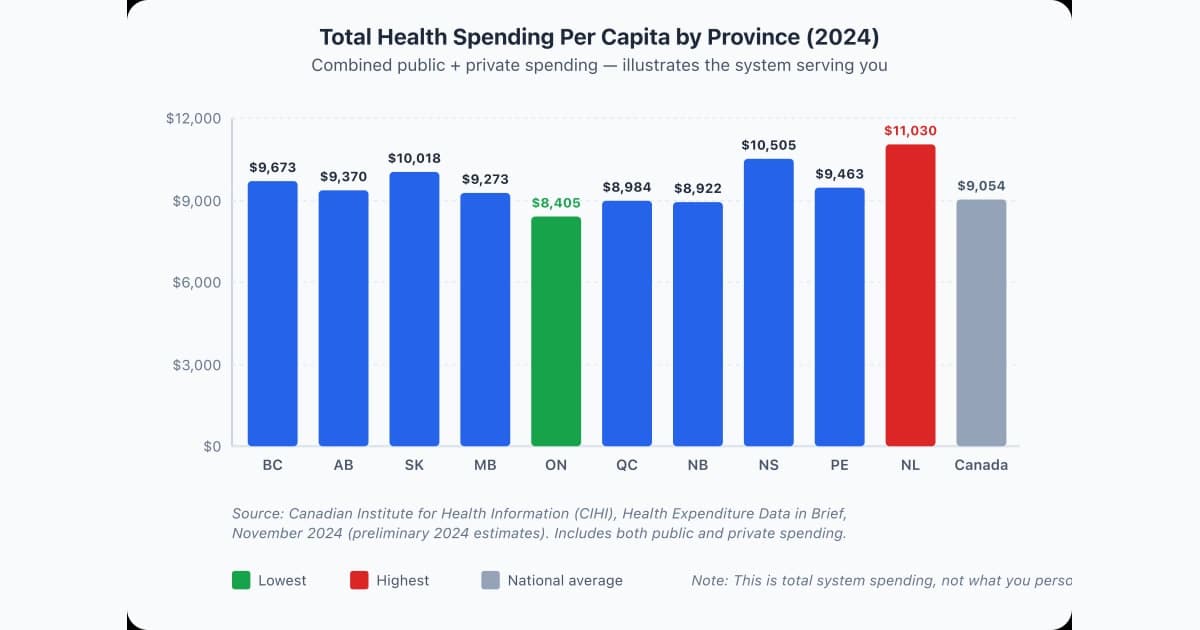
The chart below shows total health spending (public + private combined) per person, by province, for 2024. You don't pay this directly — it's the system spending behind your care — but it tells you which provinces operate heavier vs leaner systems.
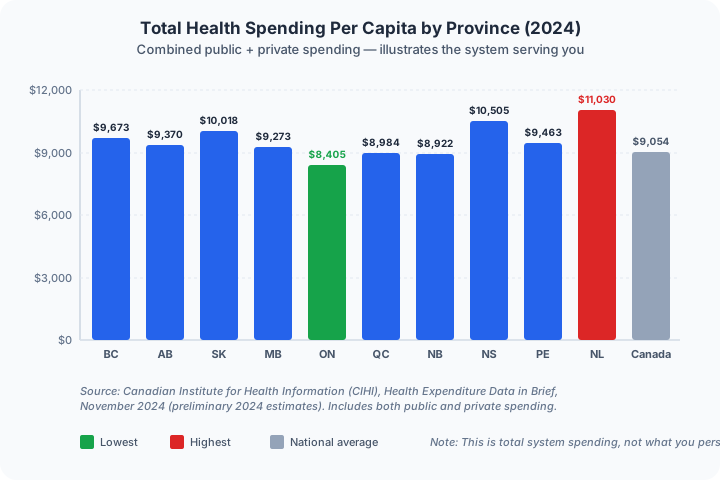
Source: CIHI Health Expenditure Data in Brief, November 2024.
Long-Term Care — The Big Tail Risk
Many Canadians don't consider long-term care when planning, yet the odds of needing it rise sharply with age — and for those who do, it can be one of the largest single expenses in retirement. That makes it worth planning for even if you may never use it. Two very different cost worlds:
- Publicly subsidized long-term care — basic accommodation roughly $2,000–$3,000/month per resident depending on province (~$2,085 in Ontario for basic; ~$2,148 in Alberta for a shared room, rising for private rooms; income-tested in BC). Most provinces offer rate reductions for low-income residents. (Ontario LTC rates; Alberta continuing-care accommodation charges)
- Private retirement homes — often not subsidized, commonly $3,000–$7,000+/month per resident depending on services and location.
For region-specific cost modelling — home-care hours, retirement homes, and long-term care across seven Canadian regions — see the Cost of Ageing Calculator, an independent research tool developed by the National Institute on Ageing at Toronto Metropolitan University (research led by Dr. Bonnie-Jeanne MacDonald and He Chen). It pairs well with RetireZest: the COA Calculator estimates the cost side; RetireZest models the income and withdrawal side.
Three common ways Canadian retirees plan for it:
- Self-fund a 3–5 year stay from your portfolio
- Use home equity — sell or reverse-mortgage the family home (see downsizing your home in retirement)
- Long-term care insurance — possible, but premiums are significant and the Canadian market has tightened
Want to see if your savings can cover this? RetireZest builds a comprehensive retirement plan where your healthcare estimates sit alongside CPP, OAS, taxes, and withdrawals — so you can stress-test a long-term care scenario in minutes.
→ Try RetireZest free — no credit card required.
A Simple Healthcare Budget for Your Retirement Plan
You don't need precision — you need a reasonable range that climbs with age. The figures below are per person; couples should plan for roughly double.
Active years (65–74): $2,000–$4,000/year for most healthy retirees in a province with reasonable drug coverage. More if you have ongoing prescriptions or extensive dental work.
Moderate years (75–84): $3,000–$6,000/year. Prescriptions, hearing aids, glasses, and dental tend to add up.
Quiet years (85+): $5,000–$10,000+/year, plus a long-term care contingency. This is where home care and possible facility costs enter the picture.
These ranges are starting points, not targets. Your actual number depends on health, province, and whether you carry private retiree benefits.
RetireZest lets you enter these healthcare estimates as part of your retirement plan — three age phases, one-time costs, or a sustained long-term care budget — and shows how they affect your year-by-year cash flow and final estate. See how it works at retirezest.com.
Frequently Asked Questions
How much should I budget for healthcare in retirement in Canada?
A reasonable per-person starting range is $2,000–$4,000/year in your active years (65–74), $3,000–$6,000/year through your mid-80s, and $5,000–$10,000+/year after that plus a long-term care contingency. Couples should plan for roughly double. For context, the average Canadian household spent $3,087 on healthcare in 2023 (Statistics Canada).
Which province has the lowest drug costs for seniors?
Alberta and Ontario offer premium-free senior drug plans with low per-prescription co-pays. Quebec's RAMQ charges an income-based annual premium of $0–$766. British Columbia is fully income-tested with no automatic senior benefit. Low-income seniors in Quebec or Ontario may pay close to zero.
How much does long-term care cost in Canada?
Publicly subsidized long-term care accommodation is roughly $2,000–$3,000/month per resident for a basic room (~$2,085 in Ontario; ~$2,148 in Alberta for a shared room, more for private; income-tested in BC). Semi-private and private subsidized rooms cost more (around $2,500–$3,000+/month in Ontario). Private retirement homes commonly run $3,000–$7,000+/month per resident. Most provinces offer rate reductions for low-income residents.
What healthcare costs are not covered by provincial plans?
Provincial plans generally cover doctor visits and hospital care. Most retirees pay out of pocket for prescription drugs (with provincial offsets), dental, vision (glasses, most procedures), hearing aids ($2,000–$6,000 per pair), most physiotherapy and mental health, home care, and long-term care accommodation fees.
Should I buy long-term care insurance in Canada?
It's an option, but premiums tend to be significant and the Canadian market has narrowed sharply — most major insurers (RBC, Manulife, and Sun Life's stand-alone product) have stopped selling new stand-alone long-term care policies, leaving only a few products. Many retirees instead plan to self-fund a 3–5 year stay from their portfolio, use home equity, or rely on provincial subsidies. The best choice for your household could depend on your net worth, family situation, and risk tolerance — a financial planner can model the tradeoffs.
Key Takeaways
- Budget $2,000–$6,000 per person per year out of pocket for healthcare in your active and moderate years; more in your 80s+ (couples roughly double)
- The biggest variable is prescription drug coverage, which differs sharply by province
- The biggest tail risk is long-term care, at $2,000–$3,000/month per resident for subsidized basic rooms (more for private rooms) or $3,000–$7,000+/month per resident in private retirement homes
- Average Canadian household healthcare spending was $3,087 in 2023 (Statistics Canada)
- A flat healthcare budget for 30 years of retirement may understate later-life costs — split it into active, moderate, and quiet phases
Related Articles
Frequently asked questions
How much should I budget for healthcare in retirement in Canada?
A reasonable starting range is $2,000–$4,000/year in your active years (65–74), $3,000–$6,000/year through your mid-80s, and $5,000–$10,000+/year after that plus a long-term care contingency. The average Canadian household spent $3,087 on healthcare in 2023 (Statistics Canada).
Which Canadian province has the lowest drug costs for seniors?
Alberta and Ontario offer premium-free senior drug plans with low per-prescription co-pays. Quebec's RAMQ charges an income-based annual premium of $0–$766. British Columbia is fully income-tested with no automatic senior benefit. Low-income seniors in Quebec or Ontario may pay close to zero.
How much does long-term care cost in Canada?
Publicly subsidized long-term care accommodation is roughly $1,700–$2,900 per month for a basic room (~$2,036 in Ontario; $1,700–$2,200 in Alberta; income-tested in BC). Private retirement homes commonly run $3,000–$7,000+ per month. Most provinces offer rate reductions for low-income residents.
What healthcare costs are not covered by provincial plans in Canada?
Provincial plans generally cover doctor visits and hospital care. Most retirees pay out of pocket for prescription drugs (with provincial offsets), dental, vision (glasses, most procedures), hearing aids ($2,000–$6,000 per pair), most physiotherapy and mental health, home care, and long-term care accommodation fees.
Should I buy long-term care insurance in Canada?
It is an option, but premiums are significant and the Canadian market is limited. Many retirees instead plan to self-fund a 3–5 year stay from their portfolio, use home equity, or rely on provincial subsidies. The right choice depends on your net worth, family situation, and risk tolerance — a financial planner can model the tradeoffs.
Add healthcare costs to your plan
Model rising healthcare spending through your later phases and see whether the plan still holds.
Stress-test my planThis article is for educational purposes only and does not constitute financial, tax, medical, or legal advice. Figures are drawn from the Canadian Institute for Health Information (CIHI) Health Expenditure Data in Brief (November 2024), Statistics Canada's Survey of Household Spending (2023), the Cost of Ageing Calculator by the National Institute on Ageing at Toronto Metropolitan University, and provincial government sources cited inline. Out-of-pocket cost ranges are estimates derived from these sources and may not reflect your situation. Provincial drug program details, premiums, and long-term care rates change regularly — check the relevant provincial site for current figures before making decisions. RetireZest is not a registered financial advisor, dealer, tax professional, or healthcare provider. Always consult licensed professionals before making financial or care-related decisions.
Related Articles

Average Retirement Spending in Canada: What's Normal? (2026)
What do Canadian retirees actually spend? A clear 2026 breakdown by category, plus couple vs single — so you can see where your own number lands.

You Have Permission to Spend It (Retirement in Canada)
Many Canadian retirees underspend for years out of quiet worry. A gentle look at why — and how seeing your own numbers can give you room to enjoy it.
Canadian Retirement Numbers 2026: The Key Figures
CPP, OAS, GIS, TFSA, RRSP, RRIF minimums, and the 2026 tax thresholds that shape Canadian retirement plans — collected on one page.