How Much Do You Need to Retire in Canada? (2026)
There's no single magic number — it depends on your spending, province, and CPP/OAS. See realistic 2026 targets and how to find yours, not an average.

CPP and OAS replace only about 33% of the average Canadian's pre-retirement income. The rest has to come from your savings — and the amount you need depends on the lifestyle you want.
What's RetireZest? A Canadian retirement-planning platform built for the rules retirees actually face — CPP, OAS, GIS, RRSP, RRIF, TFSA, and corporate (CCPC) accounts. It's a planning tool, not a bank or a financial advisor: you enter your numbers, the engine runs a year-by-year simulation under current CRA rules, and you see your retirement laid out from today through your 90s. Free to use; advanced features (PDF reports, Monte Carlo stress testing, the timing optimizer) are an optional paid upgrade. (See how it compares in our guide to the best Canadian retirement planning software.)
Quick Answer: How Much Do You Need?
| Lifestyle | Monthly Spending | Savings Needed |
|---|---|---|
| Modest (single) | $2,500 | ~$260K |
| Comfortable (single) | $3,500 | ~$560K |
| Comfortable (couple) | $5,000 | ~$525K |
| Higher lifestyle (couple) | $7,000 | ~$1.1M |
Assumes average CPP + full OAS + 4% withdrawal rate. Your number depends on province, account types, and tax situation — calculate yours free below.
Want your personalized number? Try RetireZest free — enter your accounts, income, and spending to get a year-by-year projection in about 5 minutes.
"How much do I need to retire?" It's the most common question in retirement planning — and the most frustrating, because the honest answer is: it depends.
It depends on where you live, how much you spend, your health, whether you're single or a couple, and what government benefits you'll receive. But we can get you a concrete number.
💰 Start With What You'll Spend
Before calculating how much you need saved, you need to know how much you'll spend. For a detailed look at what Canadian retirees actually spend by category, see our retirement spending benchmarks.
🤔 The 70% Rule (and Why It's Wrong)
The old rule of thumb says you'll need 70% of your pre-retirement income. But this is wildly inaccurate for most people:
- Some retirees spend more in their early 60s (travel, hobbies, renovations)
- Some spend much less (no commuting, no work clothes, no payroll deductions)
- Housing costs may drop dramatically if your mortgage is paid off
- Healthcare costs tend to rise with age
A better approach: track your actual spending for 3–6 months, then project from there.
📊 Canadian Spending Benchmarks
According to Statistics Canada, average household spending for seniors:
| Category | Monthly (approx.) |
|---|---|
| Housing (owners, no mortgage) | $800–$1,200 |
| Food | $600–$900 |
| Transportation | $400–$700 |
| Healthcare/insurance | $200–$400 |
| Recreation/travel | $300–$800 |
| Utilities/communication | $300–$500 |
| Clothing/personal | $150–$300 |
| Total | $2,750–$4,800 |
For a couple, a comfortable retirement typically requires $4,000–$6,000/month after tax. For a single person, $2,500–$4,000/month.
🍁 What CPP and OAS Will Cover
Before touching your savings, add up your guaranteed government income:
💡 CPP (2026)
- Maximum at 65: ~$1,508/month ($18,096/year) — source: Service Canada
- Average payment: ~$804/month ($9,648/year) across all recipients
- Most Canadians get 50–70% of the maximum
💡 OAS (2026)
- Maximum at 65: ~$752/month ($9,024/year) — source: Service Canada
- Ages 75+: ~$827/month ($9,926/year) — 10% automatic increase
- Available to almost all Canadians who lived in Canada 10+ years after age 18
📊 Combined Government Income
| Scenario | Monthly | Annual |
|---|---|---|
| Single, average CPP + OAS | ~$1,548 | ~$18,576 |
| Single, maximum CPP + OAS | ~$2,252 | ~$27,024 |
| Couple, both average CPP + OAS | ~$3,096 | ~$37,152 |
| Couple, both maximum CPP + OAS | ~$4,504 | ~$54,048 |
For an average couple, CPP and OAS alone provide about $37,000/year — roughly 55–65% of a comfortable retirement budget.
🎯 The Gap: What Your Savings Need to Cover
The difference between what you need and what the government provides is your income gap. This is what your savings must fill.
Example — Couple needing $5,000/month ($60,000/year):
- Government income: ~$37,000/year
- Income gap: ~$23,000/year
- This is what your RRSP, TFSA, pension, and other savings must generate
📈 The 4% Rule (Modified for Canada)
The classic "4% rule" says you can withdraw 4% of your portfolio in year one, then adjust for inflation each year, and your money should last 30 years.
For a $23,000/year income gap:
- Required portfolio: $23,000 / 0.04 = $575,000
But the 4% rule has important caveats in the Canadian context:
- It was designed for a 30-year horizon — if you retire at 60, you may need 35+ years
- It assumes a 50/50 stock/bond portfolio — your asset allocation matters
- Canadian taxes reduce your effective withdrawal rate (RRIF withdrawals are taxable)
- Inflation in Canada has been higher recently than historical averages
- Healthcare is publicly funded in Canada, reducing one major US retirement risk
🛡️ A More Conservative Approach
Many Canadian planners recommend 3.5% for early retirees or 4.5% for those with guaranteed income (CPP, OAS, pensions) providing a solid floor.
📊 The Real Numbers by Scenario
Here's how much you'd need saved, depending on your spending and government income:
👤 Single Person
| Monthly Spending | Annual Gap | Savings Needed (4%) |
|---|---|---|
| $2,500 | $10,452 | $261,000 |
| $3,000 | $16,452 | $411,000 |
| $3,500 | $22,452 | $561,000 |
| $4,000 | $28,452 | $711,000 |
Assumes average CPP + full OAS
👥 Couple
| Monthly Spending | Annual Gap | Savings Needed (4%) |
|---|---|---|
| $4,000 | $8,904 | $223,000 |
| $5,000 | $20,904 | $523,000 |
| $6,000 | $32,904 | $823,000 |
| $7,000 | $44,904 | $1,123,000 |
Assumes both average CPP + full OAS
⚠️ What These Numbers Miss
The calculation above is a starting point, but real retirement planning needs to account for:
💰 1. Taxes
RRIF withdrawals are taxable. If you need $23,000 after tax, you may need to withdraw $28,000–$30,000 pre-tax (depending on your bracket). This increases the required portfolio.
📈 2. Inflation
$5,000/month today will feel like $3,700 in 15 years at 2% inflation. Your withdrawals need to increase over time.
📉 3. Sequence of Returns Risk
If the market drops 30% in your first year of retirement, the 4% rule can fail. This is why Monte Carlo stress testing matters.
⚠️ 4. OAS Clawback
If your income is too high, you'll lose some OAS — increasing the gap your savings must fill. See our guide on how to avoid OAS clawback.
❤️ 5. Estate Goals
Do you want to leave money to your children? That changes the math significantly.
🏥 6. Healthcare and Long-Term Care
While basic healthcare is covered, dental, vision, prescription drugs, and long-term care can add $5,000–$15,000/year in later retirement.
Want a real number for your situation, not a rule of thumb? RetireZest runs a year-by-year simulation that accounts for your province, your account types, your CPP, your spouse, and your spending — then tells you what savings you actually need.
→ Try RetireZest free — no credit card required.
✅ A Better Way to Find Your Number
Rules of thumb give you a ballpark. But your actual number depends on dozens of variables: your province (tax rates differ), your account types (RRSP vs. TFSA vs. non-registered), your CPP amount, your partner's situation, and your spending patterns.
RetireZest runs a year-by-year simulation of your retirement that accounts for all of this:
- Real tax calculations for every province and territory
- CPP and OAS based on your actual expected amounts
- Inflation adjustments to your spending
- Multiple withdrawal strategies compared side by side
- Monte Carlo analysis to stress-test against bad markets
Instead of a single number, you get a complete picture of whether your money will last — and a Zest Score that tells you where you stand. See what you can do to improve your odds.
Find your number free — it takes about 5 minutes.
🎯 Quick Benchmarks
If you just want a quick benchmark to see where you stand:
- Modest retirement (single, $2,500/month): ~$260K saved
- Comfortable retirement (single, $3,500/month): ~$560K saved
- Comfortable retirement (couple, $5,000/month): ~$525K saved
- Higher lifestyle (couple, $7,000/month): ~$1.1M saved
These assume average CPP, full OAS, and a 4% withdrawal rate. Your number could be higher or lower depending on your specific situation.
📝 The Bottom Line
There's no magic number that works for everyone. But here's the framework:
- Estimate your spending in retirement (be realistic, not optimistic)
- Add up guaranteed income (CPP + OAS + any pensions)
- Calculate the gap (spending minus guaranteed income)
- Divide by 0.04 (or 0.035 for extra safety) to find your target savings
- Run a simulation to account for taxes, inflation, and market risk
The earlier you do this calculation, the more time you have to close any gap. And if you're already close to retirement, knowing your number helps you make better decisions about whether you can retire, when to retire, and how to draw your income — including whether working one more year meaningfully changes the picture.
Frequently asked questions
How much do you need to retire in Canada in 2026?
It depends on your lifestyle. A modest retirement for a single person may require about $260,000 in savings (with CPP and OAS). A comfortable couple may need $600,000 to $1.1 million or more, depending on province, spending, and desired travel.
Can I retire with just CPP and OAS?
CPP and OAS together provide roughly $20,000 to $30,000 per year depending on your contribution history and when you start. For a modest lifestyle in a lower-cost area, this may be sufficient — but most retirees need additional savings to maintain their pre-retirement lifestyle.
Does the 4% rule work in Canada?
The 4% rule is a rough guideline — withdraw 4% of your portfolio in year one and adjust for inflation. It was developed for US markets. In Canada, with CPP, OAS, and different tax rules, the safe withdrawal rate may be higher or lower depending on your situation. A simulation that accounts for Canadian tax brackets and government benefits provides a more accurate answer.
Get your number, not the average
Fifteen minutes of your own inputs can replace the rules of thumb in this article.
Find my number freeThis article is for educational purposes only and does not constitute financial, tax, or legal advice. The figures cited are based on 2026 CRA projections and may change. RetireZest is not a registered financial advisor, dealer, or tax professional. Always consult a licensed financial advisor or tax professional before making financial decisions.
Related Articles
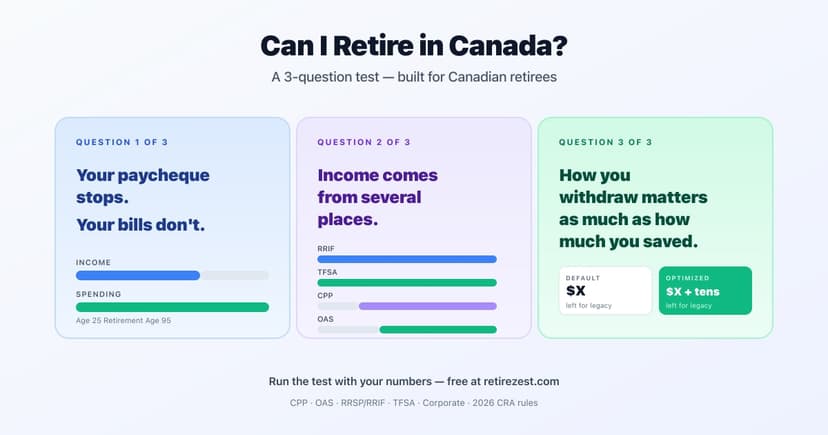
Can I Retire in Canada? A 3-Question Test (2026)
A practical 3-question test for whether you can retire in Canada — spending vs. income, where that income comes from, and why withdrawal strategy matters.
Can I Retire at 60 in Canada? What Actually Decides It
Retiring at 60 means five years before OAS and a CPP decision at minus 36%. What actually decides whether it works — and how to test it on your numbers.
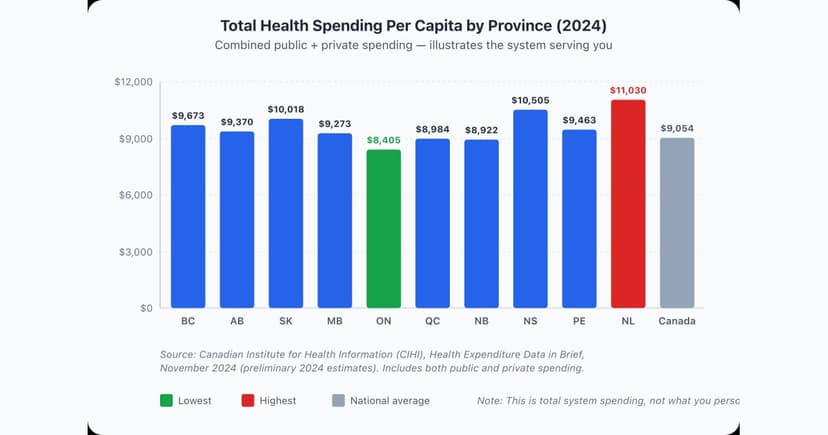
Healthcare Costs in Retirement Canada (2026 Budget Guide)
What should Canadian retirees budget for healthcare? Roughly $2,000–$6,000/year per person out of pocket, plus drug and long-term care costs by province.