Is Your Retirement on Track? Let's Take the Road Trip
Think of retirement as a road trip. Can I afford the whole trip, what goes to taxes, is there enough for the next trip, and can I pay for each day?

The short version. You may have worked for decades for this trip. A retirement plan can feel like a wall of numbers, but it may help to picture it as a road trip. Think of each day as one year of your retirement. Your nest egg is your travel budget, and each day you pay for gas, meals and a hotel: your spending for that year. Four questions can tell you a lot about the trip: can you afford the whole trip, how much goes to taxes along the way, will there be enough left for the next trip, and can you pay for each day as planned.
What is RetireZest? A Canadian retirement-planning platform built around the rules retirees live with: CPP, OAS, GIS, RRSPs, RRIFs, TFSAs and corporate accounts. It is a planning tool, not a bank or a financial advisor. You enter your own numbers, it works through your retirement year by year, and you see the whole trip laid out in front of you. It is free to start, with optional paid features.
Plan your own road trip
Start my plan"Will we be OK?"
When people think about their retirement plan, the question on their mind is often not about returns or tax brackets. It is simpler than that: will we be OK? Will there be enough to pay for our cost of living, even as prices go up with inflation? For the trips with the grandchildren, for the roof that needs replacing, for the years when one of you may need more care?
Those are big questions, and it is easy to feel lost in them. A road trip can make them feel more familiar. Many people already know how to plan one: you think about where you are going, how long it will take, what each day may cost, and whether your budget covers it.
On this trip:
- Each day is like one year of your retirement. A 30-year retirement is a 30-day trip.
- Your travel budget is your nest egg: your savings, investments, RRSPs, TFSAs, and your corporation if you have one.
- Each day you pay for gas, meals and a hotel. That is your spending for the year: your home, food, car, travel and gifts.
- Money comes in along the way: CPP, OAS, pensions, rent, interest, dividends and capital gains.
- And many travellers keep an emergency fund aside, just in case. That is your cushion.
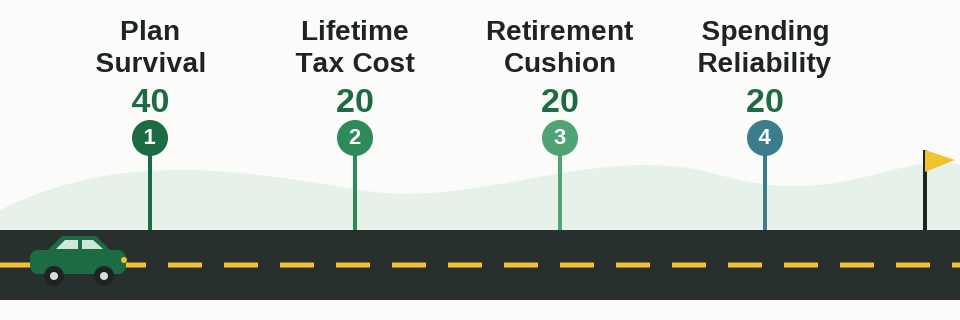
Four questions for your trip
1. Can you afford the whole trip?
For many people, this is the question that matters most. No trip goes exactly as planned. Some days are sunny. Some are rainy or snowy, and once in a while the road may even be closed for a time. Markets are a lot like the weather: they have good years and hard years, and a few hard years may come right after you leave.
Picture taking the same trip hundreds of times, in all kinds of weather. How many of those trips reach the end with every day, every year of retirement, paid for? A plan that arrives in 9 trips out of 10 may feel very different from one that arrives in 6 out of 10.
What may help: the size of your yearly budget, when you start CPP and OAS, and the order you draw from your accounts.
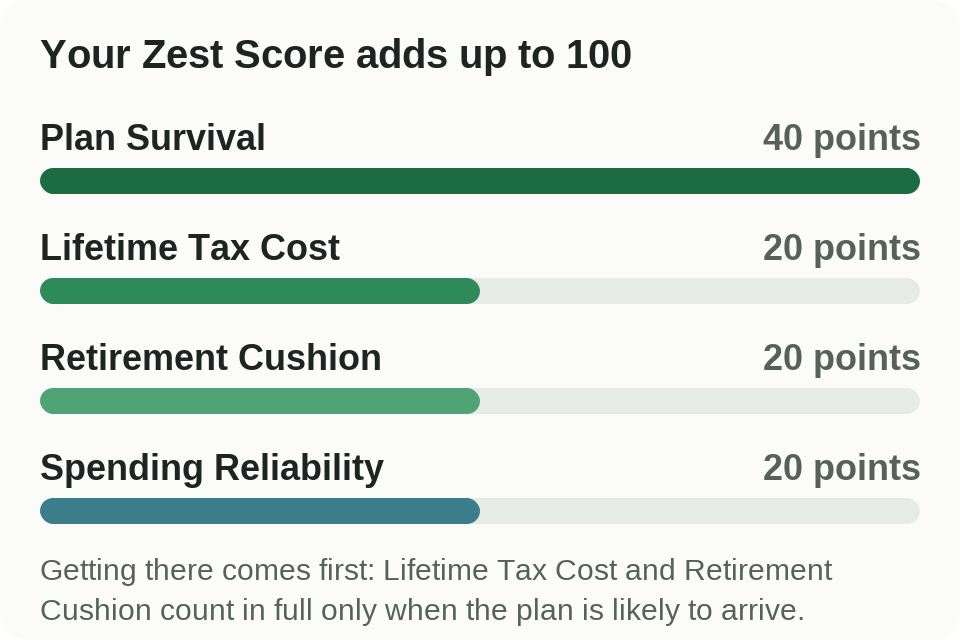
We call this part of your Zest Score Plan Survival.
2. How much goes to taxes along the way?
On a trip, part of most bills is tax, like the sales tax on a meal or a hotel room. Retirement works the same way: the higher your taxes, the more expensive the whole trip may be. The main ones are income tax, and tax inside a corporation if you have one. Some are easy to miss, and each one may leave you with less income or a smaller budget for the trip:
- The OAS clawback: when your income passes a certain line, part of your Old Age Security is paid back, so less income comes in along the way.
- A smaller GIS: the Guaranteed Income Supplement gets smaller as your other income grows, so it adds less to your trip.
- Provincial premiums: such as the Ontario Health Premium, paid with your tax return when your taxable income is over $20,000, or Quebec's prescription drug insurance premium, paid to Revenu Québec if you are in the public plan (most people are registered in it automatically at 65). They come out of your budget each year.
Some tax credits work in your favour. From age 65, the pension income amount is a tax credit on up to $2,000 a year of eligible pension income, such as RRIF payments (CPP and OAS do not count). RetireZest includes it in your taxes.
Other costs work like taxes too, even though they are not called that:
- Fees on your investments: they often come out every year, quietly. That is why it helps to enter your growth rates after fees.
- Inflation: prices tend to go up along the way, so each day of the trip may cost a little more. At 2.1% a year, spending of $60,000 today would cost about $91,000 in 20 years for the same life.
There is often more than one road to the same place. The route you take (which account you draw from, and when) can change how much tax you pay over the whole trip. RetireZest calculates how much tax you may pay on each route: some roads may cost less in tax, others more.
What may help: trying a different withdrawal order, or keeping your income under the OAS clawback line in the years it may apply.
We call this part of your Zest Score Lifetime Tax Cost.
3. Will there be enough left for the next trip?
Many travellers keep an emergency fund aside. You hope you won't need it, but it is there if the car breaks down, if someone gets sick, or if you decide to stay a few more days.
In retirement, that emergency fund is your cushion. It can help if you live longer than you planned, if a health cost comes out of nowhere, or if a child or grandchild needs a hand. And if you never need it, it may be what you leave to the people you love, or the start of your next trip.
What may help: drawing down large RRIFs a little earlier, or deciding together how much you hope to leave.
We call this part of your Zest Score Retirement Cushion.
4. Can you pay for each day as planned?
A trip can still reach the end and have some hard days along the way, and each of those days is like a year of your retirement: a car repair on day 12 (a big, unexpected cost in your 12th year), a tight budget near the end. In retirement, those are the years when the plan covers less than you hoped to spend.
What may help: adding the big costs you can see coming (a new car, a roof, a family wedding) as one-time expenses, so the plan sets money aside for them on purpose. Many people also spend a bit more in their active years and a bit less in their quiet years, and a plan can reflect that.
We call this part of your Zest Score Spending Reliability.
Why one percentage may not be enough
Many retirement tools give you a single number: a gauge that says your goal is 144% funded, or one chance of success. It is a comforting number to see. But it may not tell the whole story.
Some of those numbers come from a plan that assumes your savings grow at the same steady rate every single year. Real markets rarely move that way. A few bad years early in retirement, while you are drawing from your savings, can matter much more than the average. A plan that looks 144% funded on a smooth, straight road may look very different on the real one, with its hills and potholes.
And knowing your money may last mostly answers the first question: can you afford the whole trip? It may say little about how much went to taxes along the way, what was left in your emergency fund, or whether each year was paid as planned. That is why RetireZest takes your trip through hundreds of different markets, good and bad, not just one steady one, and why the Zest Score looks at the whole trip.
Getting there comes first
RetireZest calculates your Zest Score for the whole trip: one number from 0 to 100 that brings these four questions together. Think of it like a credit score for your retirement plan. Affording the whole trip counts the most, 40 of the 100 points. And low taxes and a full emergency fund count in full only when the plan is likely to arrive, because saving on taxes may be little comfort if the money runs out on the way.
One couple, two road trips
Ana and Marc are an invented couple, both 65 and retiring this year, with about $900,000 in savings plus CPP and OAS. They try two budgets. Everything else stays the same.
| Trip A: $70,000 a year | Trip B: $85,000 a year | |
|---|---|---|
| Plan Survival (40) | Arrives in 90 of 100 trips: 27 | Arrives in 60 of 100 trips: 13 |
| Lifetime Tax Cost (20) | 12% of spending in tax: 18 | 14% of spending in tax: 12 |
| Retirement Cushion (20) | About 60% of savings left: 15 | About 25% of savings left: 7 |
| Spending Reliability (20) | 98% of the budget paid: 19 | 92% of the budget paid: 14 |
| Zest Score | 79, healthy with room to grow | 46, some areas to work on |
Neither trip is necessarily wrong. The score shows that, with Trip B, there is about a 40% chance the plan may not make the whole trip if nothing changes.
Some couples take that chance on purpose. They want to travel while they can, and they may cut back later if the road gets hard. Another couple may prefer the safer road: Trip A arrives in about 9 trips out of 10, with more left for the unexpected.
The Zest Score helps you see the trade-off, so the choice stays yours.
Ana and Marc are invented and their figures are rounded for the example. The points follow RetireZest's scoring rules as of November 2026.
How to check your own trip
- List your accounts with their balances and growth rates: RRSPs, RRIFs, TFSAs, LIRAs, savings, GICs and investments.
- Add your income, such as CPP, OAS and any pension, and when each one starts.
- Add your spending, including the big costs you can see coming.
- Run your plan. RetireZest calculates your Zest Score for the whole trip, part by part.
If you would like to keep the idea handy, you can download the 2-page road trip guide (PDF), with the example above. For the full details on how the score works, see the Zest Score explained.
Retirement is a trip most of us take only once. It may feel lighter when you can see the road ahead. Start your plan: it is free, no credit card needed.
Plan your own road trip
A free plan lays out your trip year by year, with your own accounts, benefits and spending. Most people finish in about 15 minutes.
Start my planEducational content only. Not personalized financial advice. RetireZest provides projections, not recommendations. Dollar amounts in this article are illustrative.
Related Articles
Can I Retire in Canada? A 3-Question Test (2026)
A practical 3-question test for whether you can retire in Canada — spending vs. income, where that income comes from, and why withdrawal strategy matters.

Downsizing Your Home in Retirement: A Canadian Guide
What downsizing can free up, how the principal residence exemption works, and how to test a home sale in your retirement plan before you commit.
Inflation Is Rising — Should Your Retirement Plan Change?
Canada's headline inflation jumped on gas prices. What monthly CPI numbers mean — and don't mean — for the inflation assumption in your retirement plan.