Pension Income Splitting Canada — Rules + Savings
Split up to 50% of eligible pension income with your spouse to reduce taxes. Rules, eligibility, and examples for 2026.

Pension income splitting is one of the most valuable tax strategies for Canadian retirees. It lets you allocate up to 50% of eligible pension income to your spouse or common-law partner on your tax returns. Depending on income levels and province, it may save a couple $3,000–$10,000 per year in taxes.
What's RetireZest? A Canadian retirement-planning platform built for the rules retirees actually face — CPP, OAS, GIS, RRSP, RRIF, TFSA, and corporate (CCPC) accounts. It's a planning tool, not a bank or a financial advisor: you enter your numbers, the engine runs a year-by-year simulation under current CRA rules, and you see your retirement laid out from today through your 90s. Free to use; advanced features (PDF reports, Monte Carlo stress testing, the timing optimizer) are an optional paid upgrade.
Yet many retirees don't take advantage of it, either because they don't know about it or they assume it's complicated. It's actually straightforward.
💡 How Pension Income Splitting Works
Each year when you file your tax return, you can elect to split eligible pension income with your spouse. This is a paper transfer only — no money actually changes hands. You simply report less income, and your spouse reports more.
The key form is T1032 (Joint Election to Split Pension Income). Both partners must sign it and file it with their tax returns.
✅ What You Can Split
The rules differ based on your age:
Age 65 or older — you can split:
- RRIF withdrawals (including mandatory minimums)
- Life annuity payments from a pension plan
- Registered pension plan (RPP) payments
- Amounts from a DPSP (Deferred Profit Sharing Plan)
- Certain foreign pension income
Under age 65 — you can only split:
- Life annuity payments from a registered pension plan
- Certain payments received due to the death of a spouse
You CANNOT split:
- CPP or OAS payments (CPP has its own sharing program)
- RRSP withdrawals (only RRIF qualifies)
- Employment income
- Investment income from non-registered accounts
- GIS payments
This is why converting your RRSP to a RRIF at or after 65 is strategically important — it unlocks income splitting.
📊 The Math: How Much Can You Save?
💰 Example 1: Basic Splitting
Without splitting:
- Partner A: $80,000 income (RRIF + CPP + OAS) → ~$16,400 federal+provincial tax
- Partner B: $20,000 income (CPP + OAS only) → ~$1,200 tax
- Combined tax: ~$17,600
With splitting (shift $20,000 of RRIF to Partner B):
- Partner A: $60,000 income → ~$10,800 tax
- Partner B: $40,000 income → ~$5,200 tax
- Combined tax: ~$16,000
- Annual savings: ~$1,600
🛡️ Example 2: OAS Clawback Avoidance
This is where splitting really shines. The OAS clawback starts at $95,323 in 2026.
Without splitting:
- Partner A: $105,000 income → OAS clawback of ($105,000 - $95,323) x 15% = $1,452
- Partner B: $25,000 income → no clawback
- Partner A loses $1,452 in OAS plus pays higher marginal tax
With splitting (shift $20,000 of RRIF to Partner B):
- Partner A: $85,000 income → no OAS clawback
- Partner B: $45,000 income → no clawback
- Savings: $1,452 in preserved OAS + ~$2,000 in tax bracket reduction = ~$3,452
📈 Example 3: High-Income Couple with Large RRIF
- Partner A: $140,000 (large RRIF minimums + CPP + OAS)
- Partner B: $30,000 (small CPP + OAS)
Splitting $40,000 of RRIF income:
- Reduces Partner A from $140,000 to $100,000 (saving ~$4,500 in clawback + tax)
- Increases Partner B from $30,000 to $70,000 (well below clawback threshold)
- Combined savings: $5,000–$8,000/year
🎯 The Pension Income Tax Credit Bonus
Beyond splitting, there's another benefit: the pension income tax credit. Each person who receives eligible pension income can claim a credit on the first $2,000 of that income.
- Federal credit: $2,000 x 15% = $300
- Provincial credit: varies by province (~$100–$200)
- Total: ~$400–$500 per person
Without splitting, only the pension-receiving partner gets this credit. With splitting, both partners can claim it — doubling the household benefit.
This means even couples with modest pensions may benefit from splitting at least $2,000 to the non-pension partner to unlock their credit.
🍁 CPP Sharing — A Separate Program
CPP has its own income sharing mechanism, separate from pension splitting:
- You must be living together, and at least one partner must be receiving (or have applied for) a CPP retirement pension — you don't both need to be collecting it
- You apply through Service Canada (not on your tax return)
- The split is based on years of cohabitation during contribution periods
- It's a permanent arrangement while both partners are alive
CPP sharing can complement pension income splitting, but the two are independent programs.
🤔 GIS Implications
For lower-income couples who receive the Guaranteed Income Supplement, pension splitting can be a double-edged sword:
- GIS is calculated on combined couple income — splitting doesn't reduce the total
- However, splitting can help equalize incomes if one partner is near a benefit threshold
- For GIS-eligible couples, the TFSA-first strategy is usually more impactful than pension splitting
📝 Step-by-Step: How to Split Pension Income
- Determine eligible income: Identify which income qualifies (RRIF, RPP, etc.)
- Calculate the optimal split: Use tax software or a planner to find the percentage (0–50%) that minimizes combined tax
- Complete Form T1032: Both partners fill out and sign the Joint Election form
- File with both returns: Attach the form to both tax returns
- Repeat annually: The election is made fresh each year — you can change the percentage
The optimal split percentage isn't always 50%. Sometimes 30% or 40% produces a better result, especially near bracket boundaries or OAS thresholds.
⚠️ Common Mistakes to Avoid
⚠️ 1. Splitting Too Much
If you push too much income to your spouse, they might enter a higher bracket or trigger their own OAS clawback. It's worth calculating both partners' total tax before settling on a split.
📝 2. Forgetting the T1032 Form
You must file Form T1032 with both returns. If it's missing from either, the CRA will deny the split.
⏰ 3. Not Splitting Early Enough
Many couples only discover pension splitting in their 70s. If one partner has been paying OAS clawback for years, that's money lost. Start splitting as soon as you have eligible income after 65.
🍁 4. Ignoring Provincial Differences
Provincial tax brackets and credits vary. The optimal split in Ontario may differ from Quebec or Alberta. Use province-specific calculations.
✅ How RetireZest Helps
RetireZest's simulation automatically models pension income splitting for couples. The strategy comparison shows:
- How splitting interacts with each withdrawal strategy
- The optimal split percentage for your situation year by year
- Impact on OAS clawback for both partners
- Combined household tax under each scenario
For couples, pension splitting is often a meaningful source of tax savings in the simulation.
See your splitting savings — try it free in about 5 minutes.
📝 Key Takeaways
- You can split up to 50% of eligible pension income (RRIF, RPP) with your spouse
- The election is made annually on Form T1032 — you can adjust each year
- Splitting can prevent OAS clawback, reduce marginal tax rates, and unlock the pension income credit for both partners
- RRIF income qualifies after age 65; this is a key reason to convert RRSP early
- The optimal split isn't always 50% — calculate based on both partners' full income picture
- CPP sharing is a separate program through Service Canada
For most Canadian couples in retirement, pension income splitting can meaningfully reduce your combined tax bill. It's worth reviewing each year to ensure you're not paying more tax than necessary. For a broader look at how couples can coordinate all their income sources, see our retirement income splitting guide for couples.
Frequently asked questions
What income can be split with a spouse in Canada?
After age 65, you can split up to 50% of eligible pension income with your spouse, including RRIF withdrawals, employer pensions, and annuity income. CPP cannot be split using Form T1032 — it has a separate sharing mechanism through Service Canada.
How much can pension income splitting save?
Savings vary, but couples with unequal incomes can typically save $2,000 to $8,000 per year in combined taxes. It may also help one or both partners stay below the OAS clawback threshold.
How do I claim pension income splitting?
Both spouses must file Form T1032 (Joint Election to Split Pension Income) with their annual tax returns. No money actually changes hands — it is a paper election on your tax return.
See what splitting could save your household
The engine applies pension splitting automatically when it helps — see the dollar difference on your own plan.
Run our household planThis article is for educational purposes only and does not constitute financial, tax, or legal advice. The figures cited are based on 2026 CRA projections and may change. RetireZest is not a registered financial advisor, dealer, or tax professional. Always consult a licensed financial advisor or tax professional before making financial decisions.
Related Articles

Retirement Income Splitting for Couples — 2026 Guide
Canadian couples can reduce taxes by splitting retirement income. Pension splitting, CPP sharing, TFSA strategies, and coordinated withdrawals.

Best Province to Retire? Tax Comparison (2026)
Tax is one piece of where to retire. On tax alone: Ontario wins near $50K, BC near $80K, Alberta at $120K+. 2026 AB/BC/ON/QC comparison.
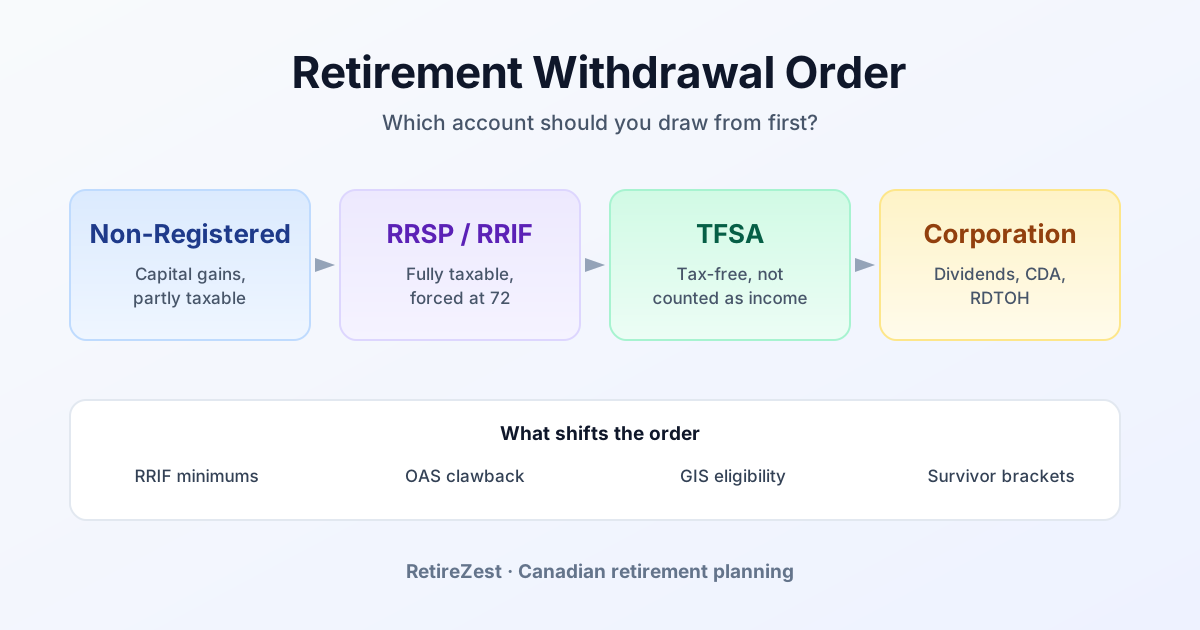
Retirement Withdrawal Order in Canada — Which Account First? (2026)
RRSP, TFSA, non-registered, or corporation first? The conventional order often doesn't fit. See what shifts it — OAS clawback, GIS, RRIF minimums, survivorship.