RRSP vs TFSA in Retirement — Which to Draw First (2026)
Should you withdraw from your RRSP or TFSA first in retirement? It depends on your tax bracket, OAS clawback risk, and long-term plan.
You've spent decades saving in RRSPs and TFSAs. Now you're in retirement, and both accounts have money. Which one should you draw from first?
What's RetireZest? A Canadian retirement-planning platform built for the rules retirees actually face — CPP, OAS, GIS, RRSP, RRIF, TFSA, and corporate (CCPC) accounts. It's a planning tool, not a bank or a financial advisor: you enter your numbers, the engine runs a year-by-year simulation under current CRA rules, and you see your retirement laid out from today through your 90s. Free to use; advanced features (PDF reports, Monte Carlo stress testing, the timing optimizer) are an optional paid upgrade.
This is a common — and consequential — decision Canadian retirees face. This article compares the two accounts head to head; if you also hold non-registered or corporate money, the broader sequencing question is covered in our guide to retirement withdrawal order in Canada.
Compare withdrawal strategies →
💡 The Basic Difference
RRSP/RRIF withdrawals are taxable income. Every dollar you take out is added to your taxable income for the year, just like employment income.
TFSA withdrawals are tax-free. They don't count as income for any purpose — not for income tax, not for OAS clawback, not for GIS calculations.
This difference is the foundation of every withdrawal strategy.
🏦 The Case for Drawing RRSP/RRIF First
The most commonly recommended strategy for retirees with moderate to high savings is to draw down RRSPs early, especially between ages 60–72:
📊 Why it works:
-
Lower tax brackets now: In early retirement, before CPP, OAS, and any pensions start, your income is low. RRSP withdrawals fill those low brackets at 20–30% instead of 40–50% later.
-
Smaller mandatory minimums: Your RRSP must convert to a RRIF by the end of the year you turn 71, with mandatory minimum withdrawals starting the following year. A smaller RRIF balance means smaller forced withdrawals that could trigger OAS clawback.
-
OAS clawback prevention: By reducing your RRIF balance before age 65, you reduce the income that counts toward the OAS clawback threshold ($95,323 in 2026).
-
Tax-free growth preserved: Meanwhile, your TFSA continues to grow tax-free. The longer money stays in a TFSA, the more tax-free growth you get.
🎯 Best for:
- Retirees with large RRSPs ($300K+)
- Those at risk of OAS clawback
- Healthy retirees who expect a long retirement
- Those who retire before 65
🛡️ The Case for Drawing TFSA First
Sometimes it makes sense to spend TFSA money first and preserve your RRSP:
📊 Why it works:
-
You're in a low bracket now: If your current marginal rate is very low (under 20%), there's less urgency to draw down the RRSP. The TFSA provides income without affecting government benefits.
-
GIS eligibility: For lower-income retirees, RRSP/RRIF withdrawals reduce your GIS benefit. TFSA withdrawals don't. Using TFSA income can help you qualify for — or maximize — GIS.
-
You need the flexibility: TFSA withdrawals are simple — no tax withholding, no reporting, and the room is restored the following year.
🎯 Best for:
- Lower-income retirees who qualify for GIS
- Those with small RRSPs that won't trigger OAS clawback
- Retirees who need tax-free cash for large one-time expenses
⚖️ The Balanced Approach
Many financial planners recommend a blended strategy:
- Withdraw from RRSP/RRIF to stay within your current tax bracket (without jumping to the next one)
- Use TFSA to top up spending needs above that
- Keep non-registered accounts for flexibility
This approach optimizes your marginal tax rate year by year, rather than committing to a single account.
💰 What About Non-Registered Accounts?
Non-registered investments add another layer. Withdrawals may trigger capital gains (50% taxable), and the account generates annual taxable income from interest and dividends.
A common approach:
- Spend non-registered interest and dividend income first (it's taxable whether you withdraw or not)
- Draw down RRSP to fill low tax brackets
- Use TFSA for top-up or large expenses
- Sell non-registered investments strategically for tax-loss harvesting — but be aware of sequence of returns risk when selling during downturns
⚠️ The RRIF Trap in Your 70s
Your RRSP must convert to a RRIF (or annuity) by the end of the year you turn 71, and mandatory minimum withdrawals begin the year you turn 72. The government sets minimum withdrawal percentages that increase with age:
| Age | Minimum Withdrawal |
|---|---|
| 72 | 5.40% |
| 75 | 5.82% |
| 80 | 6.82% |
| 85 | 8.51% |
| 90 | 11.92% |
On a $500,000 RRIF at age 80, that's a minimum withdrawal of $34,100 — all taxable. Combined with CPP and OAS, this easily pushes you into higher brackets and triggers OAS clawback.
This is why early RRSP drawdown matters. If you can reduce that RRIF balance to $300,000 by age 72 through strategic early withdrawals, your minimum at 80 drops to $20,460.
👥 How Couples Should Think About It
For couples, coordinate your withdrawals:
- Use pension income splitting: After 65, RRIF income qualifies for the pension income tax credit and can be split with your spouse
- Stagger RRSP drawdowns: If one partner has a much larger RRSP, prioritize drawing that one down
- Share TFSA usage: Both partners may benefit from maximizing TFSA contributions and using them strategically
✅ How RetireZest Helps
RetireZest's strategy comparison runs 8 different withdrawal strategies against your actual financial picture and shows you:
- Total lifetime taxes paid under each strategy
- OAS clawback impact year by year
- Whether each strategy maintains your desired spending
- The Zest Score for each approach
You can see exactly which order of withdrawals gives you the best outcome — not in theory, but for your specific situation.
Try it free and compare strategies in about 5 minutes.
📝 The Bottom Line
For most Canadian retirees with moderate-to-high savings:
- Draw RRSP/RRIF first in your early 60s to fill low tax brackets
- Use TFSA for flexibility and tax-free income when you need it
- Plan around age 72 when RRIF minimums become mandatory
- Watch the OAS threshold — keeping income below $95,323 saves you 15% on every dollar
The "right" answer depends on your numbers. What matters is thinking it through before you start withdrawing — and if you have more than these two accounts, see the full withdrawal order guide.
Frequently asked questions
Should I withdraw from my RRSP or TFSA first in retirement?
For most retirees with moderate to high savings, drawing down the RRSP first (especially between ages 60 and 72) tends to result in lower lifetime taxes. This fills low tax brackets before CPP, OAS, and RRIF mandatory minimums start, and preserves tax-free TFSA growth for later.
Do RRSP withdrawals trigger OAS clawback?
Yes. RRSP and RRIF withdrawals are fully taxable income and count toward the OAS clawback threshold ($93,454 for OAS paid July 2026 to June 2027; $95,323 for 2026 income). Large RRIF balances can trigger significant clawback in later years.
Can I transfer RRSP money to a TFSA?
Not directly. You must withdraw from the RRSP (which triggers income tax), then contribute the after-tax amount to your TFSA if you have room. This is sometimes called an RRSP meltdown strategy and may be worth doing in low-income years.
The draw order is testable — run it
Compare TFSA-first and RRSP-first on your own balances and see the lifetime tax difference.
Test my draw orderThis article is for educational purposes only and does not constitute financial, tax, or legal advice. The figures cited are based on 2026 CRA projections and may change. RetireZest is not a registered financial advisor, dealer, or tax professional. Always consult a licensed financial advisor or tax professional before making financial decisions.
Related Articles
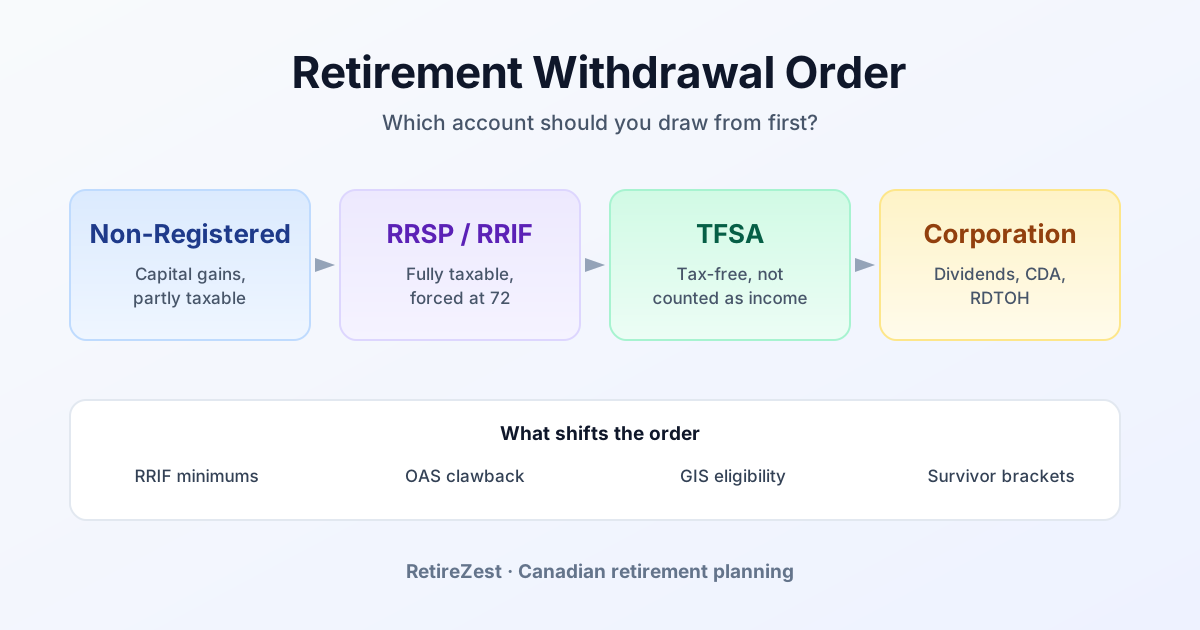
Retirement Withdrawal Order in Canada — Which Account First? (2026)
RRSP, TFSA, non-registered, or corporation first? The conventional order often doesn't fit. See what shifts it — OAS clawback, GIS, RRIF minimums, survivorship.
RRSP Meltdown Strategy — 2026 Guide
Draw down your RRSP early to avoid higher taxes later. How the meltdown strategy works, who benefits, and how to execute it.
RRIF Withdrawal Rates 2026 — By Age + Strategies
The CRA forces you to withdraw more each year — but the order you draw from RRIF, TFSA, and other accounts matters. 2026 rates by age + 5 strategies.