RRIF Withdrawal Rates 2026 — By Age + Strategies
The CRA forces you to withdraw more each year — but the order you draw from RRIF, TFSA, and other accounts matters. 2026 rates by age + 5 strategies.
RRIF withdrawals can push you into higher tax brackets and trigger OAS clawback. Here's how to minimize the damage — starting with the rates you need to know.
What's RetireZest? A Canadian retirement-planning platform built for the rules retirees actually face — CPP, OAS, GIS, RRSP, RRIF, TFSA, and corporate (CCPC) accounts. It's a planning tool, not a bank or a financial advisor: you enter your numbers, the engine runs a year-by-year simulation under current CRA rules, and you see your retirement laid out from today through your 90s. Free to use; advanced features (PDF reports, Monte Carlo stress testing, the timing optimizer) are an optional paid upgrade.
Quick Reference: RRIF Minimum Rates by Age (2026)
| Age | Minimum % |
|---|---|
| 65 | 4.00% |
| 70 | 5.00% |
| 72 | 5.40% |
| 75 | 5.82% |
| 80 | 6.82% |
| 85 | 8.51% |
| 90 | 11.92% |
| 95+ | 20.00% |
At age 72, the CRA requires you to withdraw at least 5.40% of your RRIF balance — and that rate climbs to 20% by 95. On a $500,000 RRIF, that's $27,000 at 72 and $100,000 at 95, all fully taxable. See the full table below with dollar amounts for different portfolio sizes.
Want to see your exact RRIF withdrawals and taxes? Try RetireZest free — it takes about 5 minutes.
When you turn 71, the CRA requires you to convert your RRSP into a RRIF. Starting at age 72, you must withdraw a minimum percentage every year — whether you need the money or not.
These mandatory withdrawals are fully taxable. For retirees with large RRSPs, this can push you into higher tax brackets and trigger OAS clawback. Understanding the rules — and planning ahead — can save you thousands.
📊 The Complete RRIF Minimum Withdrawal Table
The CRA sets prescribed factors for each age. You multiply your RRIF balance on January 1 by the factor for your age that year:
| Age | Minimum % | On $300K | On $500K | On $750K |
|---|---|---|---|---|
| 55 | 2.86% | $8,580 | $14,300 | $21,450 |
| 60 | 3.33% | $9,990 | $16,650 | $24,975 |
| 65 | 4.00% | $12,000 | $20,000 | $30,000 |
| 70 | 5.00% | $15,000 | $25,000 | $37,500 |
| 72 | 5.40% | $16,200 | $27,000 | $40,500 |
| 75 | 5.82% | $17,460 | $29,100 | $43,650 |
| 80 | 6.82% | $20,460 | $34,100 | $51,150 |
| 85 | 8.51% | $25,530 | $42,550 | $63,825 |
| 90 | 11.92% | $35,760 | $59,600 | $89,400 |
| 94 | 18.79% | $56,370 | $93,950 | $140,925 |
| 95+ | 20.00% | $60,000 | $100,000 | $150,000 |
Notice how the percentage accelerates — from 5.40% at 72 to nearly 12% at 90 and 20% at 95+. This is by design: the CRA wants you to draw down the account during your lifetime.
📝 Key RRIF Rules You Need to Know
⏰ Conversion Deadline
You must convert your RRSP to a RRIF by December 31 of the year you turn 71. Your first mandatory withdrawal is in the year you turn 72.
👥 Spouse's Age Option
You can elect to use your younger spouse's age to calculate minimums. If you're 75 and your spouse is 70, using their age means a 5.00% minimum instead of 5.82%. This election must be made when you set up the RRIF and cannot be changed later.
💡 No Maximum
There's no maximum RRIF withdrawal — only a minimum. You can take out as much as you want, but it's all taxable income.
💰 Withholding Tax
Amounts above the minimum are subject to withholding tax at source:
- Up to $5,000: 10% (5% in Quebec)
- $5,001–$15,000: 20% (10% in Quebec)
- Over $15,000: 30% (15% in Quebec)
These rates vary by province — Quebec has notably different withholding rules.
The minimum itself has no withholding tax at source (though it's still taxable on your return).
⚠️ Why RRIF Minimums Create Problems
⚠️ The OAS Clawback Trap
The OAS clawback starts at $95,323 of net income in 2026. For a retiree with a $750,000 RRIF at age 80:
- RRIF minimum withdrawal: $51,150
- CPP income: ~$10,560
- OAS income: ~$8,988
- Total: ~$70,698
That's manageable. But add a pension or non-registered income, and you're quickly in clawback territory.
With a $1,000,000 RRIF at 80, the minimum alone is $68,200 — and combined with CPP and OAS, you're at $87,748 before any other income.
📈 The Tax Bracket Escalator
As minimums increase with age, they push you into progressively higher brackets. A retiree who was comfortable in the 20% bracket at 72 might find themselves in the 30–40% range by 85 — not because their spending increased, but because the CRA forced larger withdrawals. Combined with sequence of returns risk in a market downturn, rising minimums on a shrinking portfolio can accelerate depletion.
🛡️ 5 Strategies to Manage RRIF Minimums
🏦 1. Draw Down Your RRSP Before 72
A commonly recommended approach for retirees with large RRSPs. If you retire before 72, make voluntary RRSP withdrawals during your low-income years (typically 60–71). This:
- Fills low tax brackets at 20–25% instead of 35–45% later
- Reduces the RRIF balance that minimums are calculated on
- Creates room to stay below the OAS clawback threshold
Example: Withdrawing $30,000/year from age 62–71 removes $300,000+ (with growth) from your future RRIF. At age 80, your minimum is calculated on a much smaller balance.
👥 2. Use Your Younger Spouse's Age
If your spouse is younger, electing their age for RRIF minimums permanently reduces your annual forced withdrawal. The younger the spouse, the bigger the benefit.
| Your Age | Your Min % | Min % Using Younger Spouse's Age | Annual Savings on $500K |
|---|---|---|---|
| 75 | 5.82% | 4.00% | $9,100 |
| 80 | 6.82% | 5.00% | $9,100 |
| 85 | 8.51% | 5.82% | $13,450 |
🛡️ 3. Convert Excess RRIF to TFSA
When you're forced to withdraw more than you need, contribute the after-tax amount to your TFSA. This:
- Shelters future growth from tax
- Creates tax-free income for later years
- TFSA withdrawals don't trigger OAS clawback or affect GIS
The 2026 TFSA annual contribution limit is $7,000 per person ($14,000 for a couple).
👥 4. Pension Income Splitting
After age 65, RRIF withdrawals qualify as eligible pension income. You can:
- Split up to 50% with your spouse on your tax returns
- Both claim the $2,000 pension income tax credit
- Equalize income to keep both partners in lower brackets
For a couple where one partner has a large RRIF and the other has little income, splitting can save $3,000–$8,000 per year in taxes.
📝 5. Coordinate with Other Income Sources
Plan your withdrawal strategy across all accounts:
- RRIF: Take only the minimum (or slightly above if in a low bracket)
- TFSA: Use for spending that would push you over the OAS threshold
- Non-registered: Time capital gains to avoid stacking on top of large RRIF minimums
🤔 The RRIF-to-Annuity Option
Some retirees convert part of their RRIF to a life annuity. This:
- Provides guaranteed income for life
- Removes the balance from RRIF minimum calculations
- Reduces longevity risk
However, annuity income is still fully taxable, and you lose control of the capital. This works best for the portion of your RRIF that covers essential expenses.
✅ How RetireZest Helps
RetireZest's simulation engine models your RRIF minimums year by year, showing exactly how they interact with your CPP, OAS, and other income. The strategy comparison tool tests whether early RRSP drawdown, TFSA-first, or a balanced approach gives you the best after-tax outcome.
You can see:
- Your projected RRIF minimum at every age
- When (and if) you'll hit OAS clawback territory
- How much early RRSP drawdown could save you
- The optimal withdrawal order for your specific situation
Run your RRIF projection free — it takes about 5 minutes.
📝 Key Takeaways
- RRIF minimums start at 5.40% at age 72 and rise to 20% at 95+
- You can use your younger spouse's age to reduce minimums permanently
- Early RRSP drawdown before 72 can help control future minimums
- RRIF income qualifies for pension splitting and the pension income credit after 65
- Excess withdrawals can be sheltered in a TFSA for tax-free growth
The RRIF rules aren't optional — but how much they cost you is largely within your control. The earlier you start planning, the more options you have.
Frequently asked questions
What is the RRIF minimum withdrawal rate at age 72?
At age 72, the CRA-mandated RRIF minimum withdrawal rate is 5.40% of your RRIF balance. This percentage increases each year — reaching 6.82% at 80, 8.51% at 85, and 20% at 95+.
Can I reduce my RRIF minimum withdrawal?
You cannot go below the CRA minimum, but you can use your younger spouse's age when setting up the RRIF to permanently lower the percentage. You can also draw down your RRSP before age 72 to reduce the balance that minimums are calculated on.
Do RRIF withdrawals affect OAS?
Yes. RRIF withdrawals are fully taxable income and count toward the OAS clawback threshold ($93,454 for OAS paid July 2026 to June 2027; $95,323 for 2026 income). Large RRIF balances can trigger significant OAS repayment.
See your RRIF minimums in context
Your mandatory withdrawals, the taxes they trigger, and the OAS effects — mapped year by year.
Map my RRIF freeThis article is for educational purposes only and does not constitute financial, tax, or legal advice. The figures cited are based on 2026 CRA prescribed factors and may change. RetireZest is not a registered financial advisor, dealer, or tax professional. Always consult a licensed financial advisor or tax professional before making financial decisions.
Related Articles
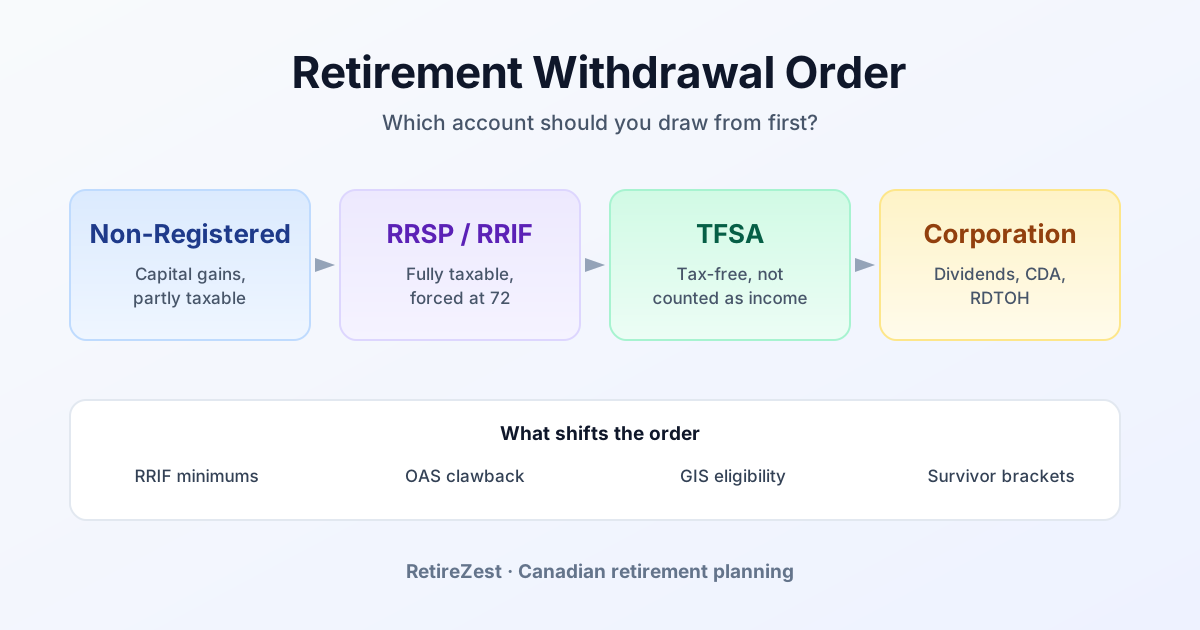
Retirement Withdrawal Order in Canada — Which Account First? (2026)
RRSP, TFSA, non-registered, or corporation first? The conventional order often doesn't fit. See what shifts it — OAS clawback, GIS, RRIF minimums, survivorship.
RRSP Meltdown Strategy — 2026 Guide
Draw down your RRSP early to avoid higher taxes later. How the meltdown strategy works, who benefits, and how to execute it.

RRSP vs TFSA in Retirement — Which to Draw First (2026)
Should you withdraw from your RRSP or TFSA first in retirement? It depends on your tax bracket, OAS clawback risk, and long-term plan.