RRSP Meltdown Strategy — 2026 Guide
Draw down your RRSP early to avoid higher taxes later. How the meltdown strategy works, who benefits, and how to execute it.

The RRSP meltdown strategy is a well-known tax-reduction technique for Canadian retirees. The idea is simple: withdraw from your RRSP earlier than required, while your income is low, to avoid much higher taxes later.
What's RetireZest? A Canadian retirement-planning platform built for the rules retirees actually face — CPP, OAS, GIS, RRSP, RRIF, TFSA, and corporate (CCPC) accounts. It's a planning tool, not a bank or a financial advisor: you enter your numbers, the engine runs a year-by-year simulation under current CRA rules, and you see your retirement laid out from today through your 90s. Free to use; advanced features (PDF reports, Monte Carlo stress testing, the timing optimizer) are an optional paid upgrade.
Many retirees instinctively protect their RRSP — letting it grow tax-deferred as long as possible. But for some, that can be the wrong approach. Here's why.
See how this applies to your plan →
⚠️ The Problem: The RRIF Tax Bomb
At age 71, your RRSP must convert to a RRIF. Starting at 72, the CRA forces minimum withdrawals that increase every year:
| Age | Minimum % | On $600K RRIF |
|---|---|---|
| 72 | 5.40% | $32,400 |
| 75 | 5.82% | $34,920 |
| 80 | 6.82% | $40,920 |
| 85 | 8.51% | $51,060 |
| 90 | 11.92% | $71,520 |
These forced withdrawals stack on top of CPP (~$10,560 average), OAS ($8,988), and any pension income. At age 80, a retiree with a $600K RRIF could have taxable income of $60,000+ before touching any other account.
The result:
- Higher marginal tax rates (30–45% combined)
- OAS clawback if income exceeds $95,323
- Reduced or eliminated GIS for lower-income retirees
- A large taxable estate if you die with a big RRIF balance
💡 The Solution: Melt It Down Early
The RRSP meltdown strategy works by deliberately withdrawing from your RRSP/RRIF before age 72, during years when your other income is low. You pay tax at lower marginal rates now to avoid much higher rates later.
🎯 The Sweet Spot: Ages 60–71
For most retirees, the optimal meltdown window is between retirement and age 71, particularly:
- Before CPP starts (if delaying to 65–70)
- Before OAS starts at 65
- Before mandatory RRIF minimums at 72
During this window, your taxable income may be very low — sometimes just employment insurance, part-time work, or small pension payments. This creates room to withdraw from your RRSP at favorable tax rates.
📊 The Tax Bracket Sweet Spot (2026)
Using federal brackets from tax_config_canada_2026.json:
| Taxable Income | Federal Rate | Approx. Combined (ON) |
|---|---|---|
| $0–$16,452 | 0% (BPA) | 0% |
| $16,452–$53,891 | 14% | 19.05% |
| $53,891–$58,523 | 14% | 23.15% |
| $58,523–$107,785 | 20.5% | 29.65% |
| $107,785–$117,045 | 20.5% | 31.66% |
If you can keep your RRSP withdrawals within the first two brackets (~$58,000 taxable income), you're paying roughly 19–23% combined tax. That same money withdrawn at age 80, stacked on top of CPP + OAS + pension, could be taxed at 35–45%.
Want to see what a meltdown could save you over your lifetime? RetireZest compares the meltdown strategy against five other withdrawal approaches and shows you the lifetime tax difference in real dollars — for your exact situation, not a generic example.
→ Try RetireZest free — no credit card required.
📝 Step-by-Step Meltdown Plan
🤔 Year 1–2: Assess Your Position
- Calculate your RRSP/RRIF balance and project what mandatory minimums will look like at 72, 80, 85
- Map your income sources by year: When does CPP start? OAS? Pensions?
- Identify the low-income window: Which years have the most room in low tax brackets?
✅ Year 3+: A Common Meltdown Approach
Some retirees who pursue this strategy follow a pattern like this (consult a tax professional for your situation):
- Withdraw RRSP to fill lower brackets each year
- Pay the tax at the current marginal rate
- Contribute after-tax proceeds to TFSA ($7,000/year per person in 2026)
- Invest any remainder in non-registered accounts
- Repeat annually until RRIF minimums at 72 are manageable
📊 Example: $800K RRSP at Age 62
Without meltdown (let it grow to 72):
- RRSP grows to ~$1,050,000 by age 72 (at 3% real return)
- RRIF minimum at 72: $56,700
- At 80: $71,600
- Combined with CPP ($10,560) + OAS ($8,988) = $91,000+ at age 80
- OAS clawback territory, high marginal rates
With meltdown ($50,000/year from 62–71):
- Withdraw $500,000 over 10 years at ~22% average tax ($110,000 total tax)
- Remaining RRIF at 72: ~$380,000 (growth on reduced balance)
- RRIF minimum at 72: $20,520
- At 80: $25,900
- Combined with CPP + OAS = $45,000 at age 80
- Well below OAS clawback, lower marginal rates
Potential savings: Depending on tax brackets, province, and other income, the meltdown may save $80,000–$150,000 in lifetime taxes for someone with an $800K RRSP. Results vary by individual situation.
🤔 Who Benefits Most
✅ Strong Candidates:
- RRSP/RRIF balance over $400,000 (individual) or $600,000 (couple)
- Retiring before 65 with a low-income gap before CPP/OAS starts
- At risk of OAS clawback at 65+
- No defined benefit pension (or a small one)
- Healthy retirees expecting a long retirement
⚠️ Weaker Candidates:
- Small RRSP (under $200K) — minimums won't cause bracket issues
- Already receiving a large pension that fills low brackets
- GIS-eligible retirees — RRSP withdrawals reduce GIS; TFSA-first is usually better
- Still working full-time (income already filling brackets)
🏦 The RRSP-to-TFSA Pipeline
A popular version of the meltdown funnels withdrawn RRSP money into your TFSA:
- Withdraw $30,000 from RRSP (taxed at ~22% = $6,600 tax)
- Net after tax: $23,400
- Contribute $7,000 to your TFSA (2026 limit)
- Contribute $7,000 to spouse's TFSA
- Invest remaining $9,400 in non-registered account
Over 10 years, this moves ~$140,000 into TFSAs that will never be taxed again — not on growth, not on withdrawal, not on death (with successor holder). Every dollar in the TFSA is a dollar that won't trigger OAS clawback or GIS reduction.
⚠️ Common Mistakes
⚠️ 1. Withdrawing Too Much
If you overshoot and jump into a high bracket, you lose the benefit. The optimal withdrawal fills your current bracket to the top — not beyond.
⏰ 2. Not Coordinating with CPP/OAS Timing
The meltdown works best when you delay CPP to 65–70, keeping those years income-free. Starting CPP at 60 while melting down the RRSP compresses the tax savings.
💰 3. Forgetting Withholding Tax
RRSP withdrawals are subject to withholding tax that rises with the amount: 10% on the portion up to $5,000, 20% on $5,001–$15,000, and 30% above $15,000 (lower rates in Quebec, plus provincial). This isn't a separate tax — it's a prepayment. But it does reduce the cash available to invest in TFSAs.
🍁 4. Ignoring Province-Specific Brackets
Provincial brackets matter. A meltdown in Alberta (lowest first bracket: 8%) is more favorable than in Quebec (first bracket: 14%). Know your province's rates.
🎯 How RetireZest Helps
RetireZest's strategy comparison directly models the RRSP meltdown (called "RRIF Meltdown" in the simulator). It runs the strategy year by year and shows:
- Your projected RRIF balance at every age
- How meltdown compares to TFSA-first, balanced, and other strategies
- The tax savings in real dollars
- Whether you stay below OAS clawback thresholds
- The Zest Score for each approach
You can see exactly how much the meltdown saves for your specific situation — not a generic estimate.
Model your RRSP meltdown free — it takes about 5 minutes.
✅ Key Takeaways
- The RRSP meltdown withdraws from your RRSP early (ages 60–71) at low tax rates to avoid high rates later
- It reduces future RRIF mandatory minimums and OAS clawback risk
- The RRSP-to-TFSA pipeline is among the most tax-efficient versions of this strategy
- Best for retirees with $400K+ RRSP who retire before 65
- Typical lifetime tax savings: $80,000–$150,000 for large RRSPs
- Coordinate with CPP timing — delaying CPP creates the low-income window the meltdown needs
The meltdown isn't about being aggressive with your money. It's about being strategic with your taxes. Pay a little now to save a lot later.
Frequently asked questions
What is the RRSP meltdown strategy?
The RRSP meltdown strategy involves making voluntary RRSP withdrawals during low-income years (typically between retirement and age 71) to fill low tax brackets. This reduces your future RRIF balance and avoids higher taxes when mandatory minimums begin at 72.
When is the best time to start an RRSP meltdown?
The optimal window is typically between retirement and age 71, when your income is low and before CPP, OAS, and RRIF mandatory minimums create unavoidable taxable income.
Can I move RRSP money to a TFSA?
Not directly. You must withdraw from the RRSP (which triggers tax), then contribute the after-tax amount to your TFSA (if you have room). This converts taxable savings into permanently tax-free savings.
Test a meltdown on your numbers
Compare RRSP-meltdown against 7 other strategies — same plan, same assumptions, side by side.
Compare strategies freeThis article is for educational purposes only and does not constitute financial, tax, or legal advice. The figures cited are based on 2026 CRA rates and may change. RetireZest is not a registered financial advisor, dealer, or tax professional. Always consult a licensed financial advisor or tax professional before making financial decisions.
Related Articles

RRSP vs TFSA in Retirement — Which to Draw First (2026)
Should you withdraw from your RRSP or TFSA first in retirement? It depends on your tax bracket, OAS clawback risk, and long-term plan.
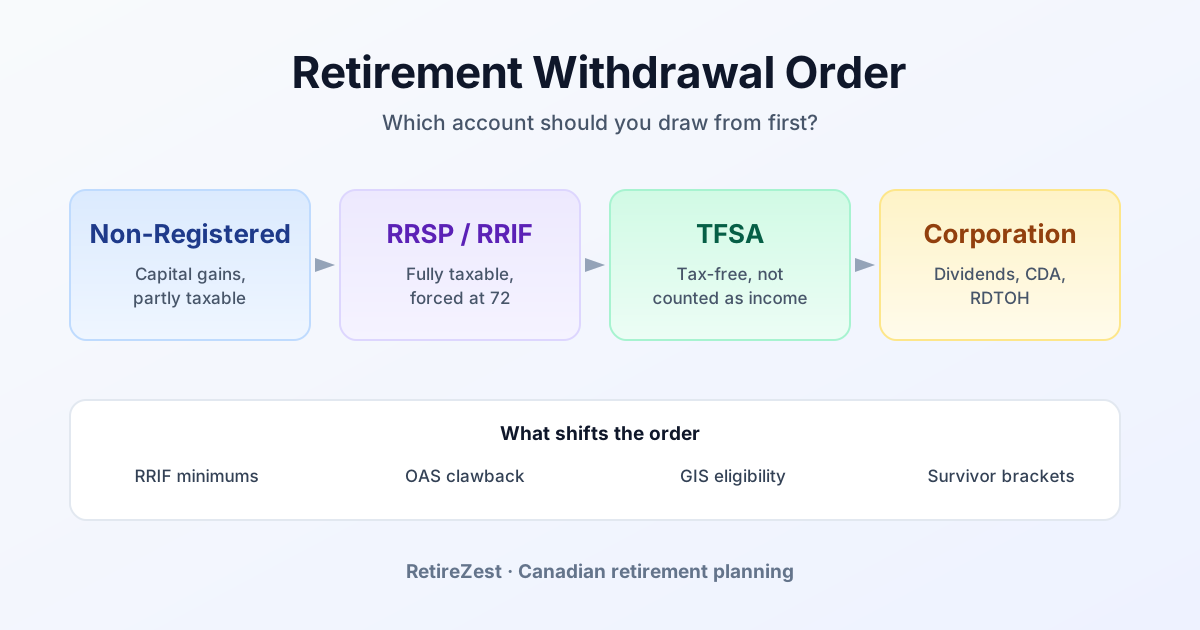
Retirement Withdrawal Order in Canada — Which Account First? (2026)
RRSP, TFSA, non-registered, or corporation first? The conventional order often doesn't fit. See what shifts it — OAS clawback, GIS, RRIF minimums, survivorship.
RRIF Withdrawal Rates 2026 — By Age + Strategies
The CRA forces you to withdraw more each year — but the order you draw from RRIF, TFSA, and other accounts matters. 2026 rates by age + 5 strategies.