Corporate Retirement Planning Canada — CCPC Guide
How to draw down your holding company in retirement. RDTOH, CDA, eligible vs non-eligible dividends, and withdrawal strategies.

If you're a Canadian business owner with a holding company, your retirement planning is significantly more complex than most. You have an extra pool of wealth (corporate investments) with its own tax rules — and the order in which you extract money can mean a difference of $100,000 or more over your retirement.
What's RetireZest? A Canadian retirement-planning platform built for the rules retirees actually face — CPP, OAS, GIS, RRSP, RRIF, TFSA, and corporate (CCPC) accounts. It's a planning tool, not a bank or a financial advisor: you enter your numbers, the engine runs a year-by-year simulation under current CRA rules, and you see your retirement laid out from today through your 90s. Free to use; advanced features (PDF reports, Monte Carlo stress testing, the timing optimizer) are an optional paid upgrade.
This guide covers how corporate accounts work in retirement and how to draw them down tax-efficiently. For a step-by-step look at each extraction method, see how to withdraw money from your corporation in retirement.
Model your corporate drawdown →
💰 How Corporate Investments Are Taxed
When your CCPC (Canadian-Controlled Private Corporation) earns passive investment income, the tax treatment is completely different from personal accounts:
📊 Passive Income Tax Rates (2026)
| Income Type | Federal Rate | Provincial (ON/QC) | Total Corp Tax | Refundable (RDTOH) |
|---|---|---|---|---|
| Interest | 38.67% | 11.5% | ~50.17% | 30.67% |
| Capital Gains (50% taxable) | ~19.3% | ~5.75% | ~25.1% | 30.67% of taxable half |
| Canadian Dividends | 38.33% Part IV | — | 38.33% | 100% refundable |
The key insight: much of the corporate tax on passive income is refundable when you pay yourself dividends. This is the RDTOH mechanism.
🍁 Provincial Passive Income Rates
| Province | Provincial Rate |
|---|---|
| Alberta | 8.0% |
| British Columbia | 12.0% |
| Ontario | 11.5% |
| Quebec | 11.5% |
Combined with the federal rate of 38.67%, total corporate tax on interest income ranges from roughly 46.67% (AB) to 50.67% (BC), with Ontario and Quebec near 50.17%.
🏦 The Three Corporate Accounts You Need to Understand
💡 1. RDTOH (Refundable Dividend Tax On Hand)
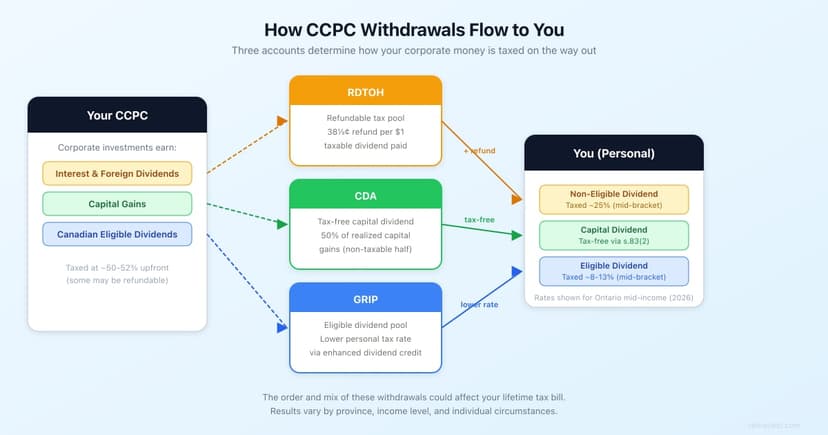
When your corporation earns passive income, a portion of the tax paid is "refundable" — it goes into the RDTOH account. When the corporation pays taxable dividends, it gets a refund:
- Refund rate: $0.3833 per $1 of taxable dividend paid (38.33%)
- Effect: The high initial corporate tax rate (~50%) drops to an effective ~20–25% after the RDTOH refund
This means the real tax cost of earning passive income inside a corporation is similar to earning it personally — by design. The CRA uses RDTOH to prevent permanent tax deferral advantages.
🛡️ 2. CDA (Capital Dividend Account)
The non-taxable portion of capital gains (50%) flows into the CDA. Money in the CDA can be paid out as tax-free capital dividends to shareholders. For a deeper look at how CDA, RDTOH, and GRIP interact, see CCPC withdrawal strategies.
Example: Your corporation realizes a $100,000 capital gain. $50,000 is taxable at corporate rates (with RDTOH). The other $50,000 goes to the CDA and can be paid to you completely tax-free.
This is a useful corporate tax planning tool worth understanding.
📈 3. The Investment Account Itself
Your corporate investment portfolio — typically holding stocks, bonds, GICs, or other assets. Growth, interest, and dividends accumulate here, with taxes flowing through RDTOH and CDA.
🤔 Eligible vs Non-Eligible Dividends
When your corporation pays you dividends in retirement, the type matters enormously for your personal tax:
📊 Eligible Dividends
- Attract a 38% gross-up (you report $1.38 for every $1 received)
- But receive a generous dividend tax credit (federal: 15.02%)
- Better for high-income retirees — the credit offsets more tax
- Sourced from: Active business income taxed at the general rate, or dividend refunds from ERDTOH
📊 Non-Eligible Dividends
- Attract a 15% gross-up (you report $1.15 for every $1 received)
- Receive a smaller dividend tax credit (federal: 9.03%)
- Better for lower-income retirees — smaller gross-up means less reported income
- Sourced from: Active business income taxed at the small business rate, or NRDTOH refunds
🎯 Mixed Dividend Strategy
Many retirees benefit from a mixed approach — paying a combination of eligible and non-eligible dividends. RetireZest models this through the corp_eligible_pct parameter (0–100%), letting you find the optimal mix.
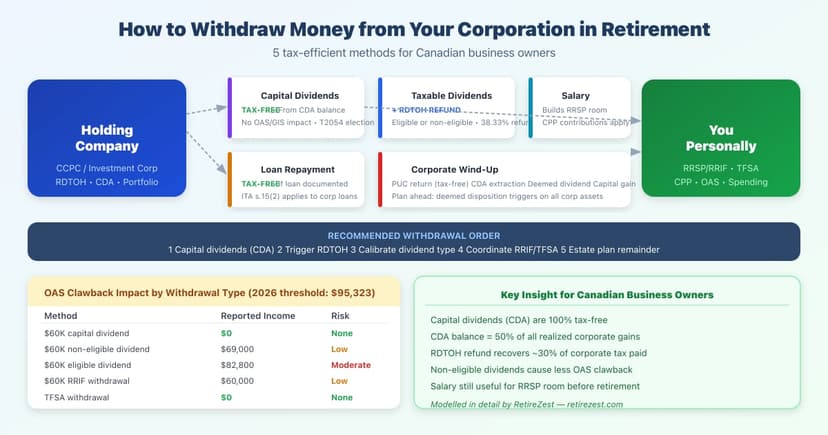
Impact on OAS: The OAS clawback uses net income, which includes the gross-up amount. A $60,000 eligible dividend reports as $82,800 in income (gross-up of 38%). A $60,000 non-eligible dividend reports as $69,000 (gross-up of 15%). The difference could save you $2,000+ in OAS clawback.
📝 Corporate Withdrawal Strategies in Retirement
The strategies below are presented for educational purposes. Corporate tax planning is complex and requires advice from a qualified accountant or tax lawyer specific to your situation.
🏦 Strategy 1: Corporate-First
Draw from the corporate account before RRIF and TFSA. This:
- Triggers RDTOH refunds (recovering corporate tax)
- Uses CDA for tax-free capital dividends
- Lets RRSP/RRIF and TFSA continue growing tax-sheltered
- Works well when RDTOH balance is large
💡 Strategy 2: Corporate + RRIF Meltdown
Combine corporate withdrawals with an RRSP meltdown:
- Draw corporate dividends for spending
- Simultaneously melt down RRSP to fill low tax brackets
- Use pension income splitting on RRIF withdrawals (after 65)
- Preserve TFSA for OAS clawback avoidance later
🛡️ Strategy 3: CDA Extraction First
If you have a significant CDA balance, extract it as capital dividends first:
- Completely tax-free to you personally
- Doesn't count as income for OAS, GIS, or tax purposes
- Then switch to taxable dividends once CDA is exhausted
🤔 Strategy 4: Salary vs Dividend Decision
In some years, paying yourself a salary instead of dividends may be better:
- Salary creates RRSP contribution room (dividends don't)
- Salary is deductible to the corporation (reduces corporate tax)
- But salary triggers CPP contributions (dividends don't)
- Typically salary is better only if you need RRSP room or want to increase CPP
📝 The Estate Planning Angle
Corporate accounts have significant estate tax implications:
⚠️ Terminal Tax on Death
When the last shareholder dies, the corporation must dispose of assets and the shares become a deemed disposition. This can trigger:
- Capital gains on share value above ACB (adjusted cost base)
- Tax on the investment portfolio inside the corporation
- Potential double taxation (corporate level + personal level)
💡 Pipeline Strategy
The "pipeline" strategy can reduce double taxation by extracting corporate value through a series of transactions after death. This is complex and requires a tax lawyer, but can save $50,000–$200,000 for large corporate balances.
🛡️ Life Insurance in the Corporation
Many business owners fund life insurance through the corporation:
- Premiums paid with lower-taxed corporate dollars
- Death benefit paid to corporation tax-free
- Death benefit added to CDA → paid to beneficiaries tax-free
This can be an efficient way to fund estate taxes or equalize inheritances.
⚠️ Common Mistakes
⚠️ 1. Ignoring RDTOH
If you have RDTOH but don't pay dividends, you're leaving refundable tax on the table. Pay enough dividends each year to trigger RDTOH refunds.
⚠️ 2. Wrong Dividend Type
Defaulting to eligible dividends when non-eligible would result in less OAS clawback or lower total tax. The optimal mix depends on your other income.
⚠️ 3. Not Using the CDA
Some business owners don't realize they have CDA room from past capital gains. Check with your accountant — you may be able to extract significant tax-free capital dividends.
⚠️ 4. Drawing Corporate Last
Many retirees instinctively draw from personal accounts first. But if your corporation has a large RDTOH balance, drawing corporate first recovers refundable taxes sooner.
🎯 How RetireZest Helps
RetireZest is one of the few Canadian retirement planning tools that models corporate accounts in full detail:
- RDTOH accumulation and refund tracking
- CDA balance and capital dividend extraction
- Eligible vs non-eligible dividend mix optimization
- Corporate passive income taxation by province (AB 8%, BC 12%, ON 11.5%, QC 11.5%)
- Year-by-year corporate balance projection
- Integration with personal RRIF, TFSA, and non-registered accounts
The strategy comparison shows how different corporate withdrawal approaches affect your lifetime taxes, OAS clawback, and Zest Score.
Model your corporate drawdown — try it free in about 5 minutes.
✅ Key Takeaways
- Corporate passive income is taxed at ~50%, but ~30% is refundable (RDTOH) when dividends are paid
- The CDA allows tax-free capital dividend extraction (from the non-taxable portion of capital gains)
- Non-eligible dividends may be better than eligible for retirees near the OAS clawback zone (smaller gross-up)
- A mixed dividend strategy (eligible + non-eligible) often produces the best result
- Corporate-first withdrawal can be optimal when RDTOH balances are large
- Estate planning is critical — pipeline strategies and corporate life insurance can save $50K–$200K
- RetireZest models RDTOH, CDA, dividend type mix, and provincial corporate rates
Corporate retirement planning isn't something you figure out on the back of an envelope. The interactions between corporate tax, personal tax, OAS clawback, and estate taxes are complex. But getting it right can be worth hundreds of thousands of dollars.
Put your corporation inside your retirement plan
Model eligible and non-eligible dividends, CDA, and RDTOH alongside your RRSP and TFSA — free to start.
Model my corporationThis article is for educational purposes only and does not constitute financial, tax, or legal advice. The figures cited are based on 2026 CRA rates and may change. Corporate tax planning requires professional advice from a qualified accountant and potentially a tax lawyer. RetireZest is not a registered financial advisor, dealer, or tax professional. Always consult licensed professionals before making financial decisions.
Related Articles
How to Withdraw From Your CCPC in Retirement
How CDA, RDTOH, and GRIP work for CCPC owners in retirement. The withdrawal method you choose may affect your lifetime tax bill.
Corporate Withdrawals in Retirement — Canada Guide
5 ways to extract money from your holding company in retirement — capital dividends, RDTOH, salary, dividends, and shareholder loans.

Best Retirement Planning Software Canada: 2026 Comparison
RetireZest, Optiml, ProjectionLab, MaxiFi & Canada.ca compared on 2026 published price, free tiers, and features — so you can pick the right Canadian tool.