Retirement Withdrawal Order in Canada — Which Account First? (2026)
RRSP, TFSA, non-registered, or corporation first? The conventional order often doesn't fit. See what shifts it — OAS clawback, GIS, RRIF minimums, survivorship.
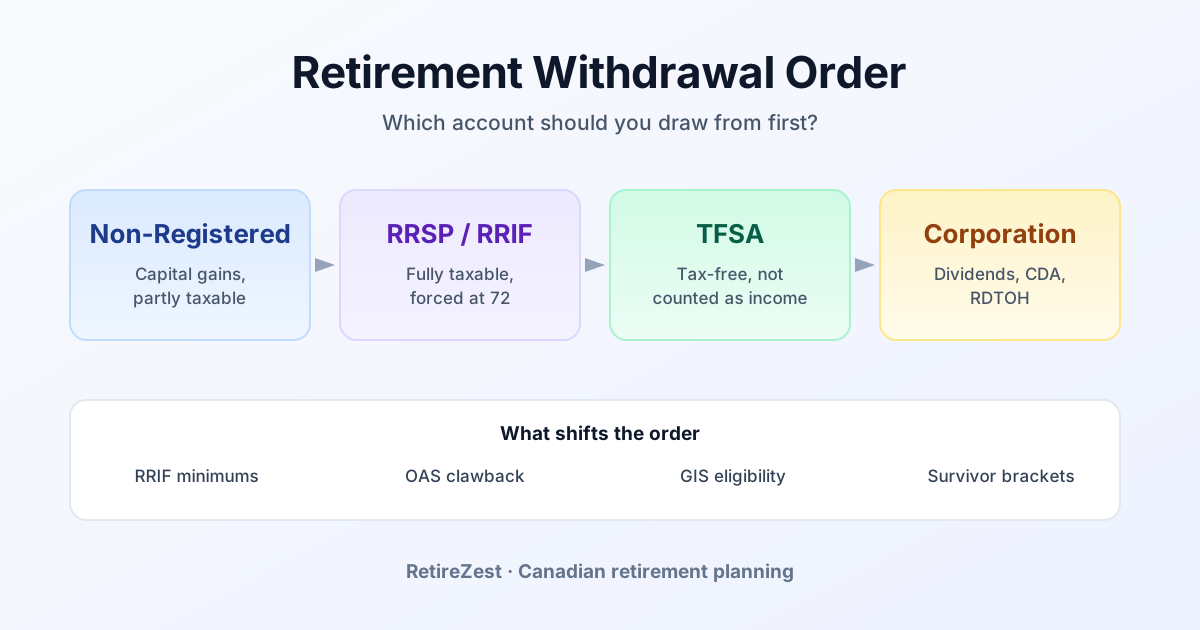
A widely repeated approach is to spend non-registered money first, then RRSP/RRIF, and leave the TFSA for last. It's a reasonable starting point — but it's a rule of thumb rather than a finding, and Canadian planners who have modelled it tend to argue that a blended approach, drawing from more than one account type in the same year, usually does better. In one published comparison of seven drawdown sequences, a blended approach left about $328,000 more estate value than the weakest sequential one (PlanEasy). Two caveats matter: that analysis dates from 2019, so it predates several years of bracket indexation and the current OAS thresholds, and it assumes an early-retired couple — age 50, $1M portfolio, modelled to 100 — a far longer horizon than a typical retirement. Treat it as evidence that the ordering decision can be worth real money, not as a figure that transfers to your plan.
What's RetireZest? A Canadian retirement-planning platform built for the rules retirees actually face — CPP, OAS, GIS, RRSP, RRIF, TFSA, and corporate (CCPC) accounts. It's a planning tool, not a bank or a financial advisor: you enter your numbers, the engine runs a year-by-year simulation under current CRA rules, and you see your retirement laid out from today through your 90s. Free to use; advanced features (PDF reports, Monte Carlo stress testing, the timing optimizer) are an optional paid upgrade.
Nothing here is a recommendation for your situation — the aim is to show which variables matter, so you can check them against your own numbers.
Compare withdrawal orders on your plan →
📋 The Conventional Order — and the Logic Behind It
The sequence you'll see repeated most often is:
- Non-registered accounts first
- RRSP/RRIF next
- TFSA last
The reasoning is tax deferral. Non-registered money was taxed on the way in, so only the growth is taxable and spending it first is relatively cheap. RRSP and RRIF withdrawals are fully taxable as income, so deferring them defers tax. And because TFSA withdrawals aren't taxable and don't count as income for any federal benefit test, leaving that account alone keeps your most flexible dollars available longest.
That logic holds on its own terms. Where it can break down is that it optimizes for this year's tax bill, while several of the biggest costs in a Canadian retirement are driven by income in later years — or by thresholds unrelated to your marginal rate. It's also worth noting that not every institutional source endorses a fixed sequence at all: Canada Life, for instance, frames the decision around where you sit in your bracket in a given year rather than a set order.
⚠️ Four Things That Commonly Shift the Order
1. The RRIF minimum schedule removes your choice at 71
You must convert your RRSP to a RRIF (or an annuity) by December 31 of the year you turn 71, and mandatory minimum withdrawals begin the following year. The CRA sets prescribed minimum factors that rise with age:
| Age | Minimum % | On a $500K RRIF |
|---|---|---|
| 72 | 5.40% | $27,000 |
| 80 | 6.82% | $34,100 |
| 85 | 8.51% | $42,550 |
| 90 | 11.92% | $59,600 |
Strictly deferring RRSP withdrawals means arriving at 72 with the largest possible balance, and so the largest forced taxable withdrawals — stacked on CPP, OAS, and any pension. For a substantial RRSP, that can mean a higher marginal rate at 80 than at 62.
This is the argument for drawing some RRSP earlier, in the low-income years between retiring and starting CPP/OAS — the logic behind the RRSP meltdown strategy. How much to pull forward depends on the gap between your bracket now and your projected bracket later, which is a per-person calculation rather than a rule. Our full RRIF minimum withdrawal table has the age-by-age figures.
2. OAS clawback adds a second rate on top of your tax bracket
Once net income passes the OAS recovery-tax threshold, 15 cents of OAS is recovered for every additional dollar of income. For 2026 income, that threshold is $95,323. It's a gradual phase-out rather than a cliff — crossing the line by a dollar costs you 15 cents, not your whole pension — but it functions as an extra 15-point rate that your tax bracket alone won't show you.
Because the recovery stacks on your regular marginal rate, income in that band can face a combined effective rate in the mid-40s to around 60%, depending on province and where you sit in the bracket. In Ontario, for example, combined rates run from about 31% to 45% across that income range (TaxTips), so adding the 15-point recovery puts the effective rate somewhere near 46–60%. That changes the arithmetic: a dollar of RRIF income taken at 63 in a 30% bracket may cost considerably less than the same dollar taken at 75 inside the clawback zone.
Crucially, TFSA withdrawals are excluded from net income, so they don't contribute to the clawback. That's why a TFSA is sometimes more useful as a pressure valve in high-income years than saved to the very end. See how the clawback is calculated for the mechanics.
3. GIS changes the picture entirely for lower-income retirees
For retirees who may qualify for the Guaranteed Income Supplement, the conventional order can work against them. GIS is income-tested, and RRSP/RRIF withdrawals count toward that test while TFSA withdrawals don't.
The reduction is steep — 50 cents of GIS lost per dollar of other income for a single recipient, and for a couple the same 50 cents applied against combined income, which works out to about 25 cents each. Either way, a modest RRIF withdrawal can carry an effective cost well above the headline tax rate. For this group, drawing TFSA first and keeping registered withdrawals low is often worth testing, the opposite of the standard advice. See GIS eligibility and how to avoid the GIS clawback.
4. The survivor faces single brackets on nearly the same income
This one is frequently missed. When one spouse dies, the survivor generally files as a single taxpayer — but a RRIF can roll over to a spouse tax-deferred, so the registered balance largely stays intact while the brackets available to draw it down are halved.
At the same time, pension income splitting ends, one OAS payment stops, and CPP survivor benefits are subject to a combined maximum rather than being additive. A couple that deferred registered withdrawals to preserve the balance can leave the survivor with a larger RRIF and a worse rate structure to draw it under. See when one spouse dies and CPP survivor benefits.
💰 A Worked Example — Same Money, Two Orders
These are simplified figures for demonstration, not a projection of anyone's actual outcome — spending, returns, and tax rules are held constant to isolate the effect of ordering alone.
A couple, both 62, retiring now, with $900,000 across accounts:
| Account | Balance |
|---|---|
| RRSP (combined) | $550,000 |
| TFSA (combined) | $180,000 |
| Non-registered | $170,000 |
Both start CPP and OAS at 65, spending roughly $70,000/year after tax.
Order A — strict conventional: spend non-registered to exhaustion, then RRIF minimums only. The RRSP compounds untouched to 71. By their mid-70s, RRIF minimums plus CPP and OAS put combined income near the clawback threshold in several years, and the survivor — filing single — is likely to sit above it.
Order B — bracket-filling: in the three years before CPP starts, withdraw from the RRSP up to the top of a lower bracket even though the money isn't needed, covering the shortfall from non-registered and a little TFSA. That lowers the balance heading into 71, and so every subsequent RRIF minimum.
The mechanism to notice: Order B pays more tax in years 1–3 and less in most years after. Whether that nets out positive depends on the bracket gap, how long the plan runs, and what happens on the first death — which is why it's worth simulating rather than assuming. Both spouses living to 95, versus a death at 78, can point to different answers from the same starting balances.
Run both orders on your own numbers →
🏢 If You Own a Corporation, There's a Fifth Account
For CCPC owners the question expands. Corporate funds have their own extraction routes and tax treatment — capital dividends from the CDA are tax-free when available, taxable dividends can trigger an RDTOH refund, and eligible versus non-eligible status changes your personal rate.
That genuinely complicates the ordering, because corporate dividends count as income for OAS clawback — and grossed-up eligible dividends inflate net income by more than the cash received, triggering clawback at a lower actual income than you'd expect. Sequencing corporate withdrawals against RRIF minimums is usually a multi-year problem. See how to withdraw money from a corporation in retirement and CCPC withdrawal strategies.
🧭 Which Considerations Tend to Apply to Which Situations
A starting point for what to test, not a prescription — most real plans cut across more than one row.
| If your situation looks like… | The factor that usually dominates | Worth testing |
|---|---|---|
| Large RRSP ($400K+), retiring before 65 | RRIF minimums and future brackets | Partial RRSP draws in the pre-CPP years |
| Income likely near $95K in your 70s | OAS clawback | TFSA to top up above the threshold |
| Modest savings, likely GIS-eligible | GIS reduction rate | TFSA first, minimal registered withdrawals |
| Significant age or health gap between spouses | The survivor's single brackets | Faster registered drawdown while both file |
| Most wealth inside a corporation | Dividend gross-up and RDTOH timing | Corporate extraction sequenced against RRIF |
| Large non-registered with big unrealized gains | Capital gains realization timing | Spreading dispositions across years |
⚖️ What Makes This Hard to Answer Generally
A few reasons the question resists a universal answer:
- The factors pull against each other. Drawing the RRSP early to reduce future RRIF minimums raises taxable income now. There's usually a trade, not a free win.
- It depends on longevity you can't know. Paying tax earlier to save later rewards a long retirement and penalizes a short one.
- Province matters. Combined marginal rates differ enough to change where bracket-filling stops making sense. See retirement taxes by province.
- Markets interact with sequencing. Drawing heavily during a downturn compounds the damage — sequence of returns risk.
- The rules change. Thresholds are indexed and legislation gets amended, so any order that's optimal today is worth revisiting.
✅ How RetireZest Approaches It
Rather than applying a rule, RetireZest runs your actual balances through eight withdrawal orders year by year under current CRA rules, reporting for each: total lifetime tax, OAS clawback by year, whether target spending is sustained, and what remains at the end. You can also model a first death partway through to see how each order treats the survivor.
The output isn't a recommendation — it's a comparison, so you can see what the ordering decision is actually worth in your case. Sometimes the spread between best and worst is large; sometimes it's small enough not to be worth optimizing, which is useful to know too.
Try it free — setup takes about 5 minutes.
📝 The Bottom Line
The non-registered → RRSP → TFSA default is a sensible starting point, and for some retirees it's close to the best available answer. But it's built on deferring tax, and several of the largest costs in a Canadian retirement — RRIF minimums at 72, the OAS recovery tax, GIS reduction, the survivor's single brackets — are driven by later-year income or by thresholds the default doesn't account for.
The takeaway isn't a different rule. It's that withdrawal order is one of the few retirement decisions genuinely testable in advance, well before you have to commit to it.
📚 Sources & Further Reading
Figures and rules above are drawn from the primary sources below, checked August 2026; the government pages cited were themselves last updated between January 2025 and August 2026. Thresholds are indexed annually — verify current numbers directly before acting on them, and note the publication dates on the commentary sources, which reflect the tax rules of their year.
Canada Revenue Agency — RRSPs and related plans · Receiving income from a RRIF · Death of a RRIF annuitant · TFSA · RRSP options when you turn 71 · Type of corporation (CCPC) · Income tax rates for individuals
Service Canada — OAS recovery tax · OAS payment amounts · Guaranteed Income Supplement · CPP survivor's pension
Analysis and commentary — PlanEasy: RRSP, non-registered or TFSA first? (seven-scenario comparison; published 2019, figures reflect the tax rules of that year) · Canada Life: tax-efficient withdrawal strategies (2022) · TaxTips: Ontario marginal tax rates
Legislation — Income Tax Act s.146.3 (RRIF minimum amount) and s.60.03 (pension splitting, 50% limit) · Income Tax Regulations s.7308, the prescribed factors behind the 5.40% / 6.82% / 8.51% / 11.92% figures above · Old Age Security Act, Part II
See your withdrawal order tested
Run your own balances through 8 withdrawal orders and compare lifetime tax, OAS clawback, and what's left at the end.
Test my draw order freeThis article is for educational purposes only and does not constitute financial, tax, or legal advice. Figures cited reflect 2026 CRA and Service Canada rules and thresholds, which are indexed and subject to change. The worked example is illustrative and simplified. RetireZest is not a registered financial advisor, dealer, or tax professional. Always consult a licensed financial advisor or tax professional before making financial decisions.
Related Articles

RRSP vs TFSA in Retirement — Which to Draw First (2026)
Should you withdraw from your RRSP or TFSA first in retirement? It depends on your tax bracket, OAS clawback risk, and long-term plan.
RRIF Withdrawal Rates 2026 — By Age + Strategies
The CRA forces you to withdraw more each year — but the order you draw from RRIF, TFSA, and other accounts matters. 2026 rates by age + 5 strategies.

RRSP Meltdown Strategy — 2026 Guide
Draw down your RRSP early to avoid higher taxes later. How the meltdown strategy works, who benefits, and how to execute it.