Zest Score — Your Retirement Readiness Score for Canada
The Zest Score is a 0–100 retirement readiness score measuring plan survival, tax efficiency, cushion, and spending reliability.

Most retirement tools give you a pile of numbers — account balances, tax projections, success rates — and leave you to figure out what it all means. The Zest Score™ condenses everything into a single 0–100 retirement readiness score, so you know exactly where you stand and where to focus.
What's RetireZest? A Canadian retirement-planning platform built for the rules retirees actually face — CPP, OAS, GIS, RRSP, RRIF, TFSA, and corporate (CCPC) accounts. It's a planning tool, not a bank or a financial advisor: you enter your numbers, the engine runs a year-by-year simulation under current CRA rules, and you see your retirement laid out from today through your 90s. Free to use; advanced features (PDF reports, Monte Carlo stress testing, the timing optimizer) are an optional paid upgrade.
Think of it like a credit score, but for your retirement plan. It measures four dimensions of retirement health — plan survival, tax efficiency, financial cushion, and spending reliability — and produces one honest number that tells you how strong your position is.
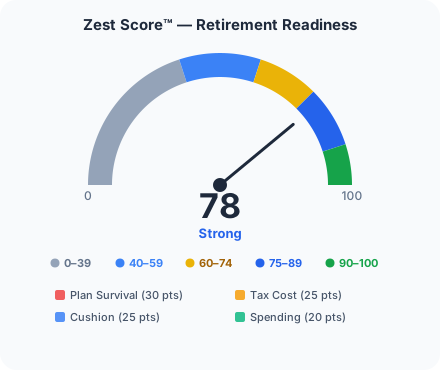
What's a Good Zest Score?
| Score | Rating | What It Means |
|---|---|---|
| 90–100 | Healthy | Well-structured across all four pillars — a strong position |
| 75–89 | Healthy — Room to Grow | Solid foundation with room to optimize |
| 60–74 | Workable — Adjustments Suggested | A good start — targeted adjustments can make a meaningful difference |
| 40–59 | Needs Improvements | Clear opportunities exist — the pillar breakdown shows where |
| Below 40 | Needs Adjustments | A plan in progress — small changes can move the needle |
We deliberately don't use an "Excellent" label — no retirement plan is ever truly finished, and the rating is meant to coach toward the next improvement rather than declare you done.
See where you stand. Try RetireZest free — run a simulation and get your Zest Score in about 5 minutes.
🎯 Why One Score?
Retirement planning generates a lot of numbers — account balances, tax bills, estate projections, Monte Carlo success rates. It's easy to get lost.
The Zest Score distills all of it into one honest number. It doesn't hide problems behind averages, and it doesn't inflate your score when the fundamentals are weak. It gives you a clear starting point: is my plan in good shape, and where should I focus?
📊 The Four Pillars
Your Zest Score is built from four pillars. Each one measures a different dimension of retirement health.
Pillar 1 — Plan Survival (30 points)
The question: Will your money last through retirement?
This is the heaviest-weighted pillar. It runs your plan through thousands of simulated market scenarios (Monte Carlo analysis) and asks: in what percentage of those scenarios does your savings, pensions, and government benefits cover your spending all the way to the end of your plan?
The higher your survival rate, the more of these 30 points you earn — a plan that holds up in nearly every scenario scores near the top, while one that frequently runs short scores low. The points scale smoothly, so there's no cliff where a small change swings your result dramatically.
A plan that runs out of money is among the biggest retirement risks. That's why Plan Survival carries the most weight — and acts as a gatekeeper for the entire score (more on that below).
What to do if this pillar is low:
- Reduce Active Years spending by 10–15%
- Consider delaying retirement by 1–2 years
- Try a different withdrawal strategy — "Balanced" or "RRIF Meltdown" often improve survival rates
- Delay CPP to age 70 for 42% more lifetime income
Pillar 2 — Lifetime Tax Cost (25 points)
The question: How much of your money goes to taxes over your entire retirement?
This pillar measures your lifetime tax cost on the income that flows through your plan — personal income tax, corporate passive tax, and OAS clawback. (Tax on your estate at death isn't counted here — it's reflected in the Retirement Cushion pillar instead, so it isn't penalized twice.)
The lower your lifetime tax cost relative to your income, the more of these 25 points you earn. Like the other pillars, it scales smoothly between anchor points rather than jumping at fixed cutoffs.
The difference between a good and poor withdrawal strategy can be $50,000 to $500,000 in taxes over a 30-year retirement. Most of that comes down to timing: which accounts you draw from, in what order, and at what income level each year.
What to do if this pillar is low:
- The RRIF Meltdown strategy draws down RRSPs early to fill lower tax brackets before CPP and OAS stack on top
- Pension income splitting with a spouse keeps both partners below higher brackets
- TFSA withdrawals are completely tax-free and don't count as income — preserving them for high-income years reduces clawbacks
- If you have a corporation, timing eligible dividend withdrawals in low-income years lowers your effective rate
Pillar 3 — Retirement Cushion (25 points)
The question: Is there a safety net if things don't go as planned?
This pillar measures your after-tax estate as a percentage of your initial portfolio. If you started with $800,000 and your projected after-tax estate is $400,000, your cushion ratio is 50%.
The larger your projected after-tax estate relative to what you started with, the more of these 25 points you earn — and the scale rewards plans that hold or grow their value, not just ones that avoid running dry. Plans that defer a lot of tax into a large terminal bill are discounted here, so a cushion that's really a future tax liability doesn't score the same as one that's already yours.
A larger cushion means you can absorb the unexpected: living longer than planned, a major health event, a market crash in your early retirement years, or a family member who needs support. It's also the legacy you leave behind.
What to do if this pillar is low:
- Even a 5–10% reduction in early spending (your active years) compounds significantly over 30 years
- Delaying CPP to 70 adds a guaranteed income stream that reduces how much you draw from savings
- A tax-efficient withdrawal strategy preserves more of your portfolio from estate taxes
- TFSA contributions in pre-retirement years grow tax-free and pass to heirs without tax
Pillar 4 — Spending Reliability (20 points)
The question: Does your plan consistently meet your desired lifestyle spending — every year?
A plan can technically survive while still having years where you can't afford what you planned. This pillar measures what percentage of your desired spending is actually met across all retirement years — the closer to meeting your full target every year, with no gaps or shortfalls, the more of these 20 points you earn.
What to do if this pillar is low:
- Review your three spending phases (active / moderate / quiet) — most retirees overestimate Quiet Years spending
- Extending your Moderate Years phase spreads spending more evenly
- A more conservative withdrawal strategy smooths income across all years
🚦 The Gatekeeper Rule
Plan Survival isn't just worth 30 points — it also caps the entire score. If your plan has a low survival rate, no amount of tax efficiency or estate value can make the overall score look good. The lower the survival rate, the tighter the cap: a plan that survives in only half its scenarios can't reach the top bands no matter how strong its other pillars are, while a plan that survives in nearly every scenario faces no cap at all.
This prevents a misleading result where someone has a great-looking estate and low taxes — but their money runs out at age 78.
🔄 How the Score Drives Strategy Recommendations
After running your simulation, RetireZest tests 7 different withdrawal strategies — each one a different approach to drawing from your RRSP/RRIF, TFSA, non-registered accounts, and corporate accounts.
Each strategy gets its own Zest Score. The one that scores highest for your specific situation is what RetireZest recommends. You can accept the recommendation and re-run with one click, or explore the tradeoffs yourself.
This means the score is doing two jobs at once: it tells you where you stand today, and it's the engine that finds a better path.
💡 How to Use Your Score
The Zest Score is a starting point, not a final answer. Here's how to get the most from it:
- Run your baseline — Enter your numbers and see where you stand today
- Read the pillar breakdown — Expand each pillar to see your specific result and what's driving it
- Try the recommended strategy — If RetireZest suggests a different withdrawal approach, run it and see the score change
- Adjust your inputs — Change retirement age, spending targets, or CPP start age and re-run to see the impact
- Bring it to your advisor — A low pillar score gives you a specific, informed question: "My tax cost pillar is low — what strategies do you recommend for my situation?"
📋 What the Score Doesn't Measure
The Zest Score is built on the information you provide. It doesn't account for:
- Lifestyle goals beyond spending numbers (travel plans, supporting family)
- Unexpected health events not reflected in your inputs
- Changes to government benefit programs
- Investment decisions or specific asset allocation within account types
It is an educational projection, not a guarantee of outcomes.
See how this applies to your plan
RetireZest models your exact situation — CPP, OAS, taxes, and withdrawal strategies — so you can see real numbers, not estimates.
Start Planning FreeRetireZest is an educational retirement planning tool and does not provide personalized financial, tax, or legal advice. RetireZest is not a registered financial advisor, dealer, or tax professional. The calculations and projections are estimates based on current government rates and the information you provide. Always consult a licensed financial advisor or tax professional before making financial decisions.
Related Articles
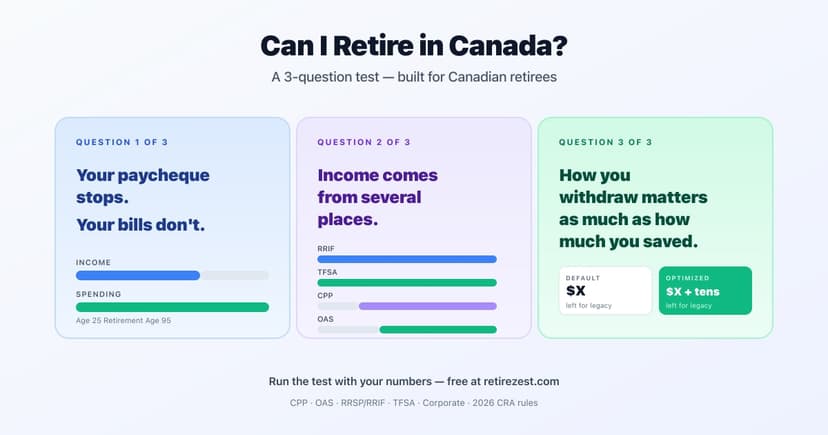
Can I Retire in Canada? A 3-Question Test (2026)
A practical 3-question test for whether you can retire in Canada — spending vs. income, where that income comes from, and why withdrawal strategy matters.

How RetireZest Helps You Learn — Education First, Always
RetireZest helps Canadians understand CPP, OAS, taxes, and withdrawal strategies through simulation. Educational tool, not financial advice.
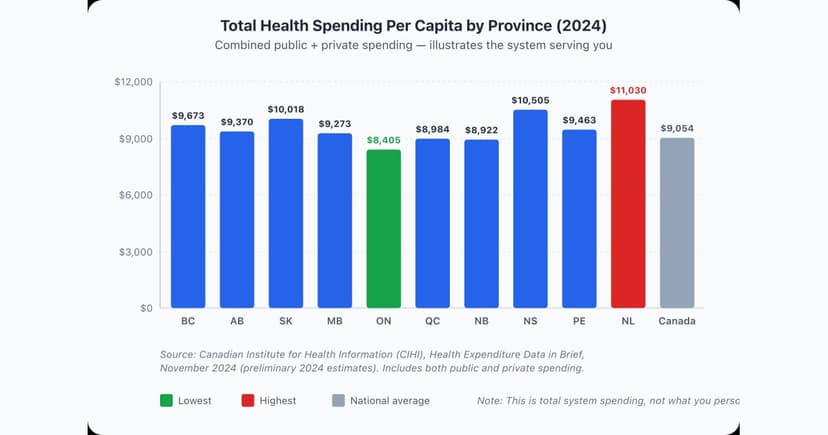
Healthcare Costs in Retirement Canada (2026 Budget Guide)
How much should Canadian retirees budget for healthcare? Out-of-pocket costs roughly $2,000–$6,000/year per person, plus drug coverage and long-term care fees by province.