Can I Retire at 60 in Canada? What Actually Decides It
Retiring at 60 means five years before OAS and a CPP decision at minus 36%. What actually decides whether it works — and how to test it on your numbers.
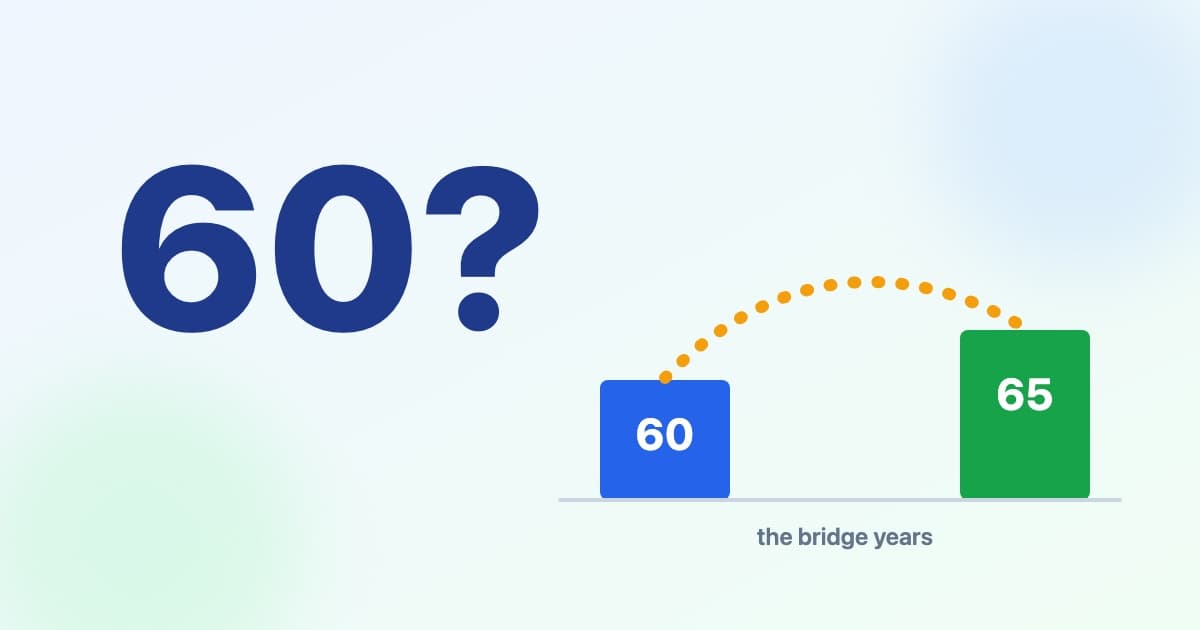
Sixty might be the most misunderstood retirement age in Canada. Ask about it and the conversation goes straight to the CPP reduction — as if that were the whole question. In our experience it's usually the smallest part of it.
TL;DR: Retiring at 60 creates a five-year gap: CPP is available (reduced 36% if you start it), but OAS and GIS don't begin until 65 — so your savings carry the household alone through the "bridge years," the stretch between your last paycheque and your first benefit cheque. Whether 60 works tends to come down to three things: how those years are funded, what a bad market early on would do, and what the CPP timing choice costs over a lifetime. All three are testable.
The three gaps at 60
1. CPP is optional — and reduced. You can start CPP at 60, at 0.6% less per month before 65 (36% less at 60). You can also retire at 60 and not start CPP — waiting to 65 or 70 while living from savings. Those are different plans with different lifetime outcomes, and the better one varies by household. Our CPP timing guide covers the trade-off in depth.
2. No OAS or GIS until 65. This is the part the CPP conversation often skips. From 60 to 65 there's generally no government retirement benefit underneath the plan (the OAS Allowance, available to some low-income 60-to-64-year-olds, is a narrow exception) — spending comes from savings, a pension if you have one, or a partner who is still working. Five years of full spending before any benefit cheque is often the largest draw a portfolio faces.
3. Benefits and coverage often end with the job. Employer health and dental plans typically stop, and private coverage in your early sixties is an expense many plans forget to include. Our healthcare costs guide has age-banded budgeting ranges.
What funds the bridge years
The usual candidates, in the order many plans consider them:
- RRSP withdrawals — the bridge years are often low-income years, which can make them a natural window for the RRSP meltdown: taking money out deliberately while your tax rate is low, before required RRIF withdrawals and government benefits push your income up later.
- Non-registered savings (a regular investment account) — flexible, though the interest and dividends it earns count as income when the government calculates benefits like OAS and GIS.
- TFSA — tax-free, and under current rules withdrawals don't count as income for those benefit calculations, which is why some plans save it for later instead of spending it first.
- A partner still working — couples retiring at different times can cover much of the bridge with one paycheque.
Locked-in accounts (a LIRA or LIF — pension money moved over from a former employer) have their own rules about how much you can take out each year, and those rules vary by province — worth checking early if most of your savings are in one.
The question under the question
"Can I retire at 60?" usually isn't a question about one number — it's a question about order and timing. The same savings that comfortably fund retirement from 65 can struggle from 60, because the earliest years are the most vulnerable to a bad market: losses in years one to five, while you're withdrawing the most with no benefits underneath, do damage that later good years may not repair.
That's why a useful answer tends to come from a year-by-year simulation rather than a savings target: set retirement at 60, choose how the bridge years are funded, pick a CPP start age, and see whether the money lasts to the age you're planning for — then test it against bad early markets. If the age-60 version looks fragile, the same simulation shows what one or two more working years, or a different CPP start, does to it.
Frequently asked questions
Can I take CPP at 60?
Yes. CPP can start any month between 60 and 70. Starting at 60 reduces the payment by 0.6% per month before 65 — 36% in total — permanently. Retiring at 60 and starting CPP at 60 are separate decisions: many people retire first and start CPP later.
Do I get OAS if I retire at 60?
No. OAS begins at 65 at the earliest (GIS as well), regardless of when you stop working. Retiring at 60 means about five bridge years funded from savings, a pension, or a partner’s income before any OAS arrives.
How much money do I need to retire at 60 in Canada?
There is no single number — it depends on spending, CPP timing, account mix, and how the five benefit-free bridge years are funded. A year-by-year simulation that models the bridge years and stress-tests early market losses gives a more reliable answer than a savings target.
Test retiring at 60 on your numbers
Set your retirement age to 60 and see the bridge years, the CPP options, and whether the money lasts to the age you're planning for.
Test age 60 freeRetireZest is an educational retirement planning tool and does not provide personalized financial, tax, or legal advice. The calculations and projections are estimates based on current government rates and the information you provide. Always consult a licensed financial advisor or tax professional before making financial decisions.
Related Articles
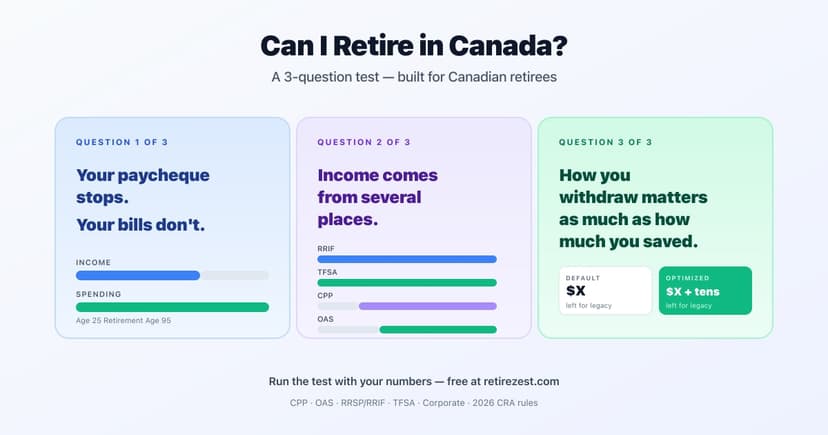
Can I Retire in Canada? A 3-Question Test (2026)
A practical 3-question test for whether you can retire in Canada — spending vs. income, where that income comes from, and why withdrawal strategy matters.

Average Retirement Spending in Canada: What's Normal? (2026)
What do Canadian retirees actually spend? A clear 2026 breakdown by category, plus couple vs single — so you can see where your own number lands.

How Much Do You Need to Retire in Canada? (2026)
There's no single magic number — it depends on your spending, province, and CPP/OAS. See realistic 2026 targets and how to find yours, not an average.